At a busy kopitiam in Bedok, there was one question that troubled everyone more than politics, property prices, and why the kopi uncle always remembered everyone’s order except yours.
The question was:
“Which stall should I queue for?”
At lunchtime, the kopitiam became a battlefield.
The chicken rice queue curled like a dragon.
The nasi lemak queue moved slower than a government form.
The fishball noodle auntie shouted numbers with the power of a national alarm system.
And at the economic rice stall, nobody knew why choosing three vegetables cost more than choosing one chicken wing.
One day, a young woman with a notebook full of Qi Men notes came to the kopitiam.
She wanted to explain Qi Men Dun Jia in a simple, funny way.
But when she put up her small poster that said:
“Understanding Qi Men Dun Jia: Ancient Strategic Wisdom for Modern Decision-Making”
everyone looked confused.
Uncle Raymond stared at the poster and said, “Wah, so chim. Can eat or not?”
Auntie Farah asked, “Qi Men is which MRT exit?”
A teenage boy said, “Dun Jia means don’t add price?”
The young woman looked at her notebook, then looked at the crowd, then looked at the chicken rice queue.
For one brief moment, she considered changing the topic to something easier.
Like quantum physics.
Then she saw an elderly man sitting calmly with a cup of kopi o kosong. His name was Uncle Boon. Everyone knew him as the kopitiam philosopher because he could explain life, CPF, and football using only kaya toast.
Uncle Boon looked at her poster and smiled.
“You want people to understand Qi Men Dun Jia?”
“Yes,” she said. “But everyone thinks it is too mysterious.”
“Then don’t start with mystery,” Uncle Boon said. “Start with lunch.”
So Uncle Boon stood up and shouted:
“Ladies and gentlemen! Today we teach you how Qi Men Dun Jia can help you survive lunchtime queue!”
Immediately, the whole kopitiam became interested.
Even the chicken rice uncle leaned forward.
Uncle Boon pointed at the stalls.
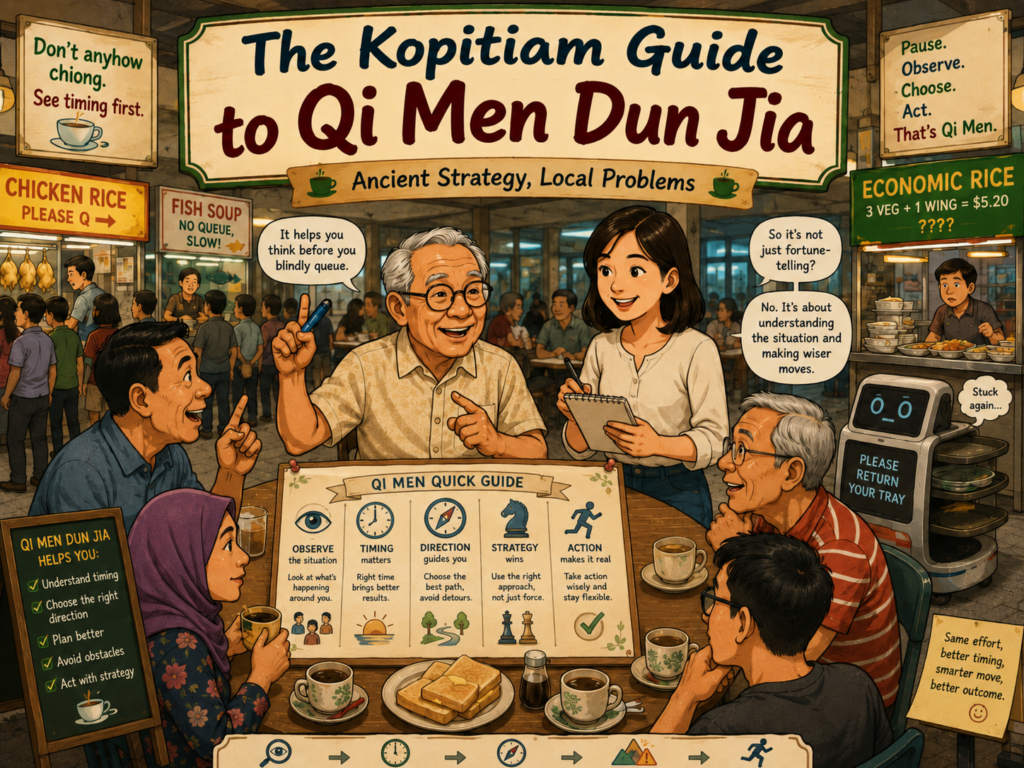
“Qi Men Dun Jia is an ancient Chinese system used for strategy. It studies timing, direction, environment, and action. In simple terms, it helps you ask: When should I act? Where should I go? What is the situation? What is the smartest move?”
Uncle Raymond raised his hand.
“So can it help me get chicken rice faster?”
The young woman smiled.
“It can help you think before you blindly queue.”
Everyone gasped.
This was revolutionary.
Uncle Boon drew a square chart on a napkin.
“This is a simplified Qi Men chart. In Qi Men Dun Jia, we divide a situation into different parts. Each part helps us understand what kind of energy or pattern may be present.”
Auntie Farah frowned. “Energy? Like electricity bill?”
“Not that kind,” said the young woman. “Think of it as the mood or condition of the moment. Some moments are good for moving forward. Some are better for waiting. Some are good for talking. Some are better for keeping quiet before you make things worse.”
Uncle Raymond nodded. “Like when my wife asks, ‘Do I look angry?’”
Uncle Boon became very serious.
“That is not a Qi Men question. That is a survival question.”
Everyone laughed.
The young woman continued.
“In Qi Men Dun Jia, there are symbols such as Doors, Stars, and other elements. They may sound mysterious, but they help us describe situations.”
The teenage boy raised his hand.
“Doors? Kopitiam got no door. It is open-air.”
“Symbolic doors,” she said. “A Door represents a type of situation. For example, some Doors may suggest movement, opportunity, rest, communication, difficulty, or delay.”
Uncle Boon pointed to the chicken rice stall.
“Look there. Very long queue, but the uncle is fast. That is like a useful Door with strong action.”
Then he pointed at the fish soup stall.
“No queue, but every bowl takes ten minutes. That is hidden obstacle.”
Then he pointed at the economic rice stall.
“Many dishes, many choices, but pricing mysterious. That one is advanced metaphysics.”
The kopitiam roared with laughter.
The young woman added, “So Qi Men is not just fortune-telling. It is a structured way of reading a situation.”
Uncle Raymond asked, “Then what are Stars?”
“Stars represent qualities and influences,” she explained. “For example, planning, leadership, creativity, confusion, delay, or problem-solving.”
A student at the next table raised his hand.
“If my homework never do, can blame bad Star?”
“No,” said the young woman. “Qi Men helps you plan. It does not help you escape responsibility.”
The student sighed. “All ancient wisdom very strict.”
Uncle Boon sipped his kopi.
“Correct. Wisdom is not here to pamper you. Wisdom is here to wake you up.”
Then the young woman explained timing.
“Qi Men also teaches that timing matters. Sometimes the same action can have a better result when done at the right time.”
Uncle Boon nodded.
“Buying kopi at 7:45am? Long queue. Everyone rushing to work. Buying kopi at 10:15am? Smooth like butter.”
The kopi uncle shouted from behind the counter, “Correct!”
“Direction also matters,” said the young woman. “But direction does not always mean just north, south, east, west. It can also mean your approach. Which way are you going to handle the matter?”
Auntie Farah said, “So if I want to talk to my husband about clearing the storeroom, I must choose the right timing and approach?”
“Yes,” said the young woman.
“Not when he is watching football?”
“Definitely not.”
“Not when he is hungry?”
“Also not.”
“Not when he says, ‘Later then do’?”
Uncle Boon shook his head.
“That means the matter has entered Delay Palace.”
Everyone laughed again.
Just then, a crisis happened.
A tray return robot rolled into the walkway and got stuck between two chairs.
It kept saying, “Please return your tray,” while blocking everyone from returning their trays.
The kopitiam froze.
Uncle Raymond panicked. “Qi Men master, what now?”
The young woman quickly said, “I am still learning, not a master.”
Uncle Boon smiled. “Good. Then this is your practical test.”
She took a breath and looked around.
“First, observe the situation. The robot is stuck. People are blocked. The auntie carrying hot soup is approaching. High risk.”
Auntie Farah stood up. “Second, identify the goal. Clear the path safely.”
Uncle Boon pointed at the chairs. “Third, choose the right action. Don’t scold the robot. It has no shame.”
The fishball noodle auntie shouted, “Move chair lah!”
A young man moved one chair. Auntie Farah guided the soup auntie around. Uncle Raymond pressed the robot’s pause button after reading the instruction sticker very slowly.
The path cleared.
The robot rolled away proudly, as if it had solved the problem itself.
Everyone cheered.
Uncle Boon smiled.
“You see? That is Qi Men thinking. Not magic. Strategy.”
The young woman turned to the crowd.
“Qi Men Dun Jia can look complicated because it has many layers. But the heart of it is practical. It helps us understand the pattern of a moment before taking action.”
She picked up a marker and wrote on her flip chart:
Qi Men Dun Jia helps us ask five smart questions:
1. What is my goal?
2. What is happening around me?
3. Is this the right timing?
4. What direction or approach should I take?
5. What action should I take now?
The kopitiam became quiet.
Even Uncle Raymond looked inspired.
Then he said, “I understand already. Qi Men Dun Jia is like choosing the best queue in life.”
Uncle Boon smiled. “Yes. But remember, even if you choose the best queue, you still must walk.”
The young woman added, “And if the queue changes, adapt.”
Auntie Farah said, “And if the stall closes?”
Uncle Boon lifted his kopi.
“Then you learn resilience and eat prata.”
Everyone clapped.
After that, people started asking real questions.
A small business owner asked, “Can Qi Men help with planning a product launch?”
The young woman said, “It can help you think about timing, positioning, communication, and possible obstacles. But you still need a good product and good effort.”
A teacher asked, “Can students use it?”
“Yes. Not to replace studying, but to plan revision better and understand when they are most focused.”
A delivery rider asked, “Can use it for route planning?”
“It can inspire strategic thinking,” she said, “but please still use GPS.”
Uncle Boon added, “Qi Men is ancient wisdom. Google Maps is modern mercy.”
By the end of lunch, the kopitiam crowd understood the message.
Qi Men Dun Jia was not about becoming mysterious.
It was not about sitting at home waiting for luck.
It was not about blaming every problem on bad energy.
It was about becoming more aware.
It was about learning to pause before reacting.
It was about reading the situation, choosing the right timing, taking the right direction, and acting wisely.
The young woman looked around and said:
“Many people think success is only about working harder. But sometimes, same effort with better timing gives better results. Same action with better direction creates less struggle. Same goal with better strategy gives a stronger outcome.”
Uncle Raymond nodded deeply.
“So don’t anyhow chiong.”
“Correct,” said Uncle Boon.
The kopi uncle raised his cup and added:
“See timing first.”
From that day on, whenever people at the Bedok kopitiam faced a problem, they did not panic immediately.
They paused.
They observed.
They considered timing, direction, obstacles, and action.
Then they made a wiser move.
Well, most of the time.
Uncle Raymond still joined the longest queue because he believed long queue means good food.
But now he called it “strategic patience.”
And the young woman kept sharing the same message wherever she went:
Qi Men Dun Jia is not about waiting for luck to find you. It is about learning how to read the moment, choose your path, and move with wisdom.
Or, as the kopi uncle put it best:
“Don’t anyhow chiong. See timing first.”
Disclaimer: All names mentioned and activities mentioned are fictional and for entertainment purposes only. Serving the public to understand what is Qi Men Dun Jia in a funny and educational way.
Leave a Reply
You must be logged in to post a comment.