1. The Physics of Time: Why Your Calendar Isn’t Neutral
Picture this: It is a humid Tuesday evening in Tanjong Pagar. Sixty-eight-year-old Auntie May stands in her living room, arms crossed over her floral blouse, staring down her niece Chloe and her fiancé Marcus. Chloe has just placed a non-refundable $8,000 venue deposit for a Saturday wedding on October 14th. Auntie May takes one look at her yellowed desktop almanac, slaps the dining table, and says, “Cancel it. If you marry on that day, you will be divorced before the lease on your first flat expires.” Marcus thinks she has lost her mind. Chloe is fuming. The venue manager refuses to refund a single dollar. But why is Auntie May so terrifyingly stubborn? Because to her, choosing a date isn’t about convenience or catering menus. It is about swimming with or against an unseen oceanic tide of cyclical time.
Let us get one thing straight right from the start: the calendar does not care about your venue deposit, your board of directors’ quarterly schedule, or your launch party catering menu. In modern Westernized business culture, we view time as a linear, featureless highway. Every hour is sixty minutes, every day is twenty-four hours, and every date on a wall calendar is an empty box waiting for you to scribble an appointment inside it. We assume that Tuesday at 9:00 AM is functionally identical to Thursday at 9:00 AM, provided your team is well-rested and your coffee is hot.
Classical Chinese temporal science, known for thousands of years as Ze Ri (择日), views the universe through a radically different lens. Time is not a blank container; it is a dynamic, pulsating environment with distinct qualitative characteristics, weather patterns, and energetic momentum. Just as an experienced ocean navigator pays close attention to tides, swell direction, and wind velocity rather than sailing blindly into a gathering hurricane, an expert practitioner in date selection studies the invisible cyclical currents of time. When you execute an action during a supportive temporal window, you sail forward with a fifty-knot tailwind behind you. When you force a major product launch or wedding during a clashing temporal window, you are rowing a leaky wooden boat straight into a massive typhoon.
For thousands of years across East Asia, no emperor ascended the throne, no military commander launched a campaign, no merchant opened a retail storefront, and no prominent family contracted a marriage without auditing the calendar. This was not blind folk custom or superstitious paranoia; it was applied pattern recognition refined over centuries of observation. Classical scholars observed that natural phenomena move in strict, predictable, mathematical cycles. The movements of the sun and moon, the seasonal shifts of ambient heat and cold, and the subtle electromagnetic fluctuations of the Earth create distinct qualitative conditions on every single day. Ze Ri is simply the tactical discipline of aligning human decisions with these broader natural currents.
Consider what happens when you ignore these temporal tides in modern enterprise. A technology startup spends eighteen months building a groundbreaking software platform. Their software engineering is pristine, their marketing budget is flushed with venture capital, and their executive team is elite. Yet they push the deployment button on a day governed by a severe personal branch clash and a destructive day officer. Within three hours, their primary payment processor suffers an unannounced global outage, their secondary server host fails, and a viral public relations misunderstanding swallows their launch narrative. The founders chalk it up to terrible luck. A classical practitioner looking at the calendar sees something far simpler: they attempted to plant delicate spring crops in the middle of a frozen mid-winter blizzard.
The core philosophy of Ze Ri rests on a simple triad: Heaven, Earth, and Man (San Cai 三才). Heaven represents timing and macro cyclical tides; Earth represents physical environment and spatial feng shui; Man represents human action, strategic competence, and personal capability. High-level execution requires all three factors working in harmony. If your business strategy is brilliant (Man) and your location is ideal (Earth), but your timing is hostile (Heaven), you guarantee unnecessary friction, delayed results, and exhausting struggle. Date selection does not guarantee that a terrible business idea will magically succeed, nor does it turn a toxic relationship into a happy marriage. What it does is remove temporal friction, allowing your strategic efforts to achieve their maximum possible yield without fighting against the background energy of the universe.
When you master Ze Ri, you stop viewing time as an enemy to be rushed or an arbitrary grid of deadlines. You begin to treat time as a strategic resource. You learn when to push aggressively, when to negotiate quietly, when to clean up internal operations, and when to sit completely still. The calendar becomes a living map of environmental momentum.
2. The Anatomic Structure of the Chinese Calendar: Stems, Branches, and Solar Cycles
Think of the Chinese calendar not as a passive paper wall hanging, but as a three-geared mechanical engine where every single gear has a distinct personality, elemental charge, and directional vector. To audit a date effectively, you must first master the symbolic vocabulary and mathematical structure of these three gears: the Ten Heavenly Stems, the Twelve Earthly Branches, and the Twenty-Four Solar Terms.
The first gear consists of the Ten Heavenly Stems (Tian Gan 天干). These represent the pure cosmic energies radiating from above, expressed through the Five Elements (Wood, Fire, Earth, Metal, Water) in alternating Yang and Yin polarities. Yang Wood (Jia 甲) resembles a towering oak tree, rigid, ambitious, and unyielding; Yin Wood (Yi 乙) resembles climbing ivy or bamboo, flexible, adaptive, and resilient. Yang Fire (Bing 丙) shines like the midday sun, brilliant, visible, and expansive; Yin Fire (Ding 丁) behaves like a candle flame or lantern, precise, warm, and focused. Yang Earth (Wu 戊) stands like a massive mountain range, solid and stable; Yin Earth (Ji 己) resembles fertile garden soil, nurturing and receptive. Yang Metal (Geng 庚) behaves like raw iron or a sharp sword, decisive and harsh; Yin Metal (Xin 辛) resembles polished jewelry, refined and delicate. Yang Water (Ren 壬) flows like a rushing river or ocean wave, powerful and surging; Yin Water (Gui 癸) falls like gentle mist or dew, quiet and penetrating.
In business operations, understanding these stem characteristics provides immediate strategic clarity. For example, a marketing campaign launched under a Yang Fire (Bing) stem gains fast public visibility and broad audience reach, whereas an internal auditing initiative launched under a Yin Fire (Ding) stem benefits from focused, meticulous analytical scrutiny.
The second gear consists of the Twelve Earthly Branches (Di Zhi 地支). If Heavenly Stems represent cosmic intentions, Earthly Branches represent terrestrial reality. They correspond to the twelve double-hour periods of the day, the twelve months of the solar year, the twelve animal archetypes, and the twelve cardinal compass directions. The twelve branches are Zi (子 – Rat / Yang Water), Chou (丑 – Ox / Yin Earth), Yin (寅 – Tiger / Yang Wood), Mao (卯 – Rabbit / Yin Wood), Chen (辰 – Dragon / Yang Earth), Si (巳 – Snake / Yin Fire), Wu (午 – Horse / Yang Fire), Wei (未 – Goat / Yin Earth), Shen (申 – Monkey / Yang Metal), You (酉 – Rooster / Yin Metal), Xu (戌 – Dog / Yang Earth), and Hai (亥 – Pig / Yin Water).
When you combine one Heavenly Stem with one Earthly Branch, you form a Stem-Branch pillar (Gan Zhi 干支), such as Bing-Zi (丙子) or Ren-Wu (壬午). Because there are ten stems and twelve branches, their lowest common multiple creates a continuous sixty-pillar cycle (Liu Shi Jia Zi 六十甲子). This sixty-pillar cycle measures time across every scale: sixty hours, sixty days, sixty months, and sixty years. Every single day in history possesses a unique Stem-Branch combination that dictates its fundamental elemental signature.
The third gear consists of the Twenty-Four Solar Terms (Jie Qi 节气). A common point of confusion among beginners is relying on lunar calendar dates (such as the first or fifteenth day of a lunar month) for technical date selection. Classical Ze Ri relies primarily on the solar calendar, which tracks the precise orbital position of the Earth around the Sun. Each solar month begins not on the lunar new moon, but on a specific Solar Term node (Jie 节), such as Li Chun (Start of Spring) or Li Dong (Start of Winter). The solar month defines which Earthly Branch governs the entire month’s seasonal energy. For example, the Solar Tiger Month (Yin Month) always begins when the sun hits 315 degrees solar longitude (around February 4th), regardless of where the moon happens to be.
To navigate the twelve Earthly Branches quickly during a live date selection audit, use the reference table below. This table outlines the elemental nature, seasonal placement, compass orientation, double-hour period, direct clash branch, and six harmony branch for every Earthly Branch.
Table 1: Master Reference Table of the Twelve Earthly Branches
| Earthly Branch | Pinyin & Character | Primary Element | Season & Month | Compass Direction | Double Hour Period | Direct Clash Branch (六冲) | Six Harmony Branch (六合) |
|---|---|---|---|---|---|---|---|
| Zi | 子 (Zi) | Yang Water | Mid-Winter (Dec) | North (0°) | 11:00 PM – 1:00 AM | Wu (午 Fire) | Chou (丑 Earth) |
| Chou | 丑 (Chou) | Yin Earth | Late Winter (Jan) | North-Northeast (30°) | 1:00 AM – 3:00 AM | Wei (未 Earth) | Zi (子 Water) |
| Yin | 寅 (Yin) | Yang Wood | Early Spring (Feb) | Northeast (60°) | 3:00 AM – 5:00 AM | Shen (申 Metal) | Hai (亥 Water) |
| Mao | 卯 (Mao) | Yin Wood | Mid-Spring (Mar) | East (90°) | 5:00 AM – 7:00 AM | You (酉 Metal) | Xu (戌 Earth) |
| Chen | 辰 (Chen) | Yang Earth | Late Spring (Apr) | Southeast (120°) | 7:00 AM – 9:00 AM | Xu (戌 Earth) | You (酉 Metal) |
| Si | 巳 (Si) | Yin Fire | Early Summer (May) | Southeast (150°) | 9:00 AM – 11:00 AM | Hai (亥 Water) | Shen (申 Metal) |
| Wu | 午 (Wu) | Yang Fire | Mid-Summer (Jun) | South (180°) | 11:00 PM – 1:00 PM | Zi (子 Water) | Wei (未 Earth) |
| Wei | 未 (Wei) | Yin Earth | Late Summer (Jul) | Southwest (210°) | 1:00 PM – 3:00 PM | Chou (丑 Earth) | Wu (午 Fire) |
| Shen | 申 (Shen) | Yang Metal | Early Autumn (Aug) | Southwest (240°) | 3:00 PM – 5:00 PM | Yin (寅 Wood) | Si (巳 Fire) |
| You | 酉 (You) | Yin Metal | Mid-Autumn (Sep) | West (270°) | 5:00 PM – 7:00 PM | Mao (卯 Wood) | Chen (辰 Earth) |
| Xu | 戌 (Xu) | Yang Earth | Late Autumn (Oct) | Northwest (300°) | 7:00 PM – 9:00 PM | Chen (辰 Earth) | Mao (卯 Wood) |
| Hai | 亥 (Hai) | Yin Water | Early Winter (Nov) | Northwest (330°) | 9:00 PM – 11:00 PM | Si (巳 Fire) | Yin (寅 Wood) |
3. The Cardinal Rule: Earthly Branch Clashes (日冲) and Personal BaZi Alignment
If you burn every other page of this manual and remember only one rule for the rest of your life, let it be this: never, under any circumstances, execute a major life event on a day that directly clashes with your personal Day Branch. In Chinese metaphysics, this is known as the Clash Day rule (Ri Chong 日冲). It is the absolute non-negotiable filter of date selection. A day can feature five brilliant virtue stars, a glowing recommendation in a popular almanac, and a pristine day officer, but if it clashes with your personal birth chart, it is poison for you.
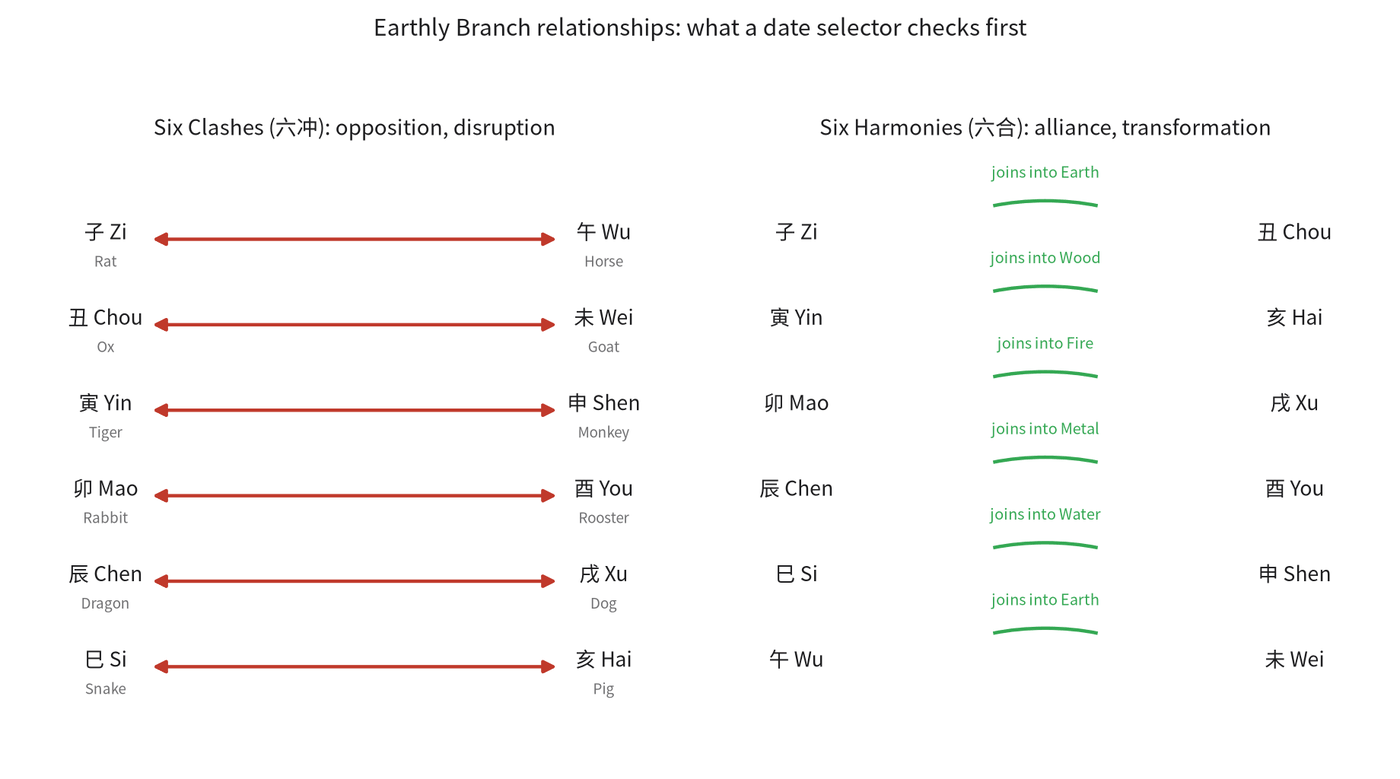
To understand why a clash is so destructive, look at the geometry of the Earthly Branches on a compass wheel. Clashing branches sit in exact 180-degree direct opposition across the wheel. Zi (North Water) directly opposes Wu (South Fire). Yin (Northeast Wood) directly opposes Shen (Southwest Metal). Mao (East Wood) directly opposes You (West Metal). When two opposing branches meet, their energies violently collide like head-on vehicular traffic. The resulting energy is unstable, turbulent, and prone to sudden ruptures.
In your personal four-pillar birth chart (BaZi 八字), you have four distinct branches: Year Branch, Month Branch, Day Branch, and Hour Branch. While all four pillars carry weight, the Day Branch (Ri Zhi 日支) represents your personal self, your physical body, your immediate physical space, and your core stability. Therefore, a clash to your Day Branch (Ri Chong) impacts you directly and personally.
Classical practitioners evaluate clashes across three hierarchical levels:
Level 1: Personal Day Clash (Ri Chong 日冲). This occurs when the Earthly Branch of the target date directly opposes your personal BaZi Day Branch. For example, if you were born on a Ren-Wu (午 Horse) day, any Zi (Rat) day is a personal clash day for you. Executing a business launch, signing a contract, or getting married on a personal clash day guarantees friction, personal fatigue, miscommunication, and structural breakdown. This is a total veto rule. No secondary positive factor can override a personal Day Branch clash.
Level 2: Year Clash or Sui Po (岁破). This occurs when the Earthly Branch of the target date directly opposes the Earthly Branch of the current year (the Grand Duke or Tai Sui 太岁). In 2026, which is the Year of the Bing-Wu (午 Horse), any Zi (Rat) day is a Sui Po day for the entire world. Sui Po days carry macro-level instability. Major institutional launches, corporate mergers, and large-scale public events should strictly avoid Sui Po days, as they attract regulatory hurdles and systemic turbulence.
Level 3: Month Clash or Yue Po (月破). This occurs when the Earthly Branch of the target date directly opposes the Earthly Branch of the current solar month. For example, during the Solar Dog Month (Xu 戌 month in October), any Chen (Dragon) day is a Yue Po day. Yue Po days represent broken monthly energy and are highly unfavorable for short-term projects or immediate commercial initiatives.
Conversely, when searching for supportive timing, practitioners look for harmonic combinations, such as the Six Harmonies (Liu He 六合) and Three Harmonies (San He 三合). As shown in Table 1, every branch has a designated Six Harmony partner (for example, Zi pairs with Chou, Yin pairs with Hai, Mao pairs with Xu). A Six Harmony relationship creates a smooth, cohesive energetic loop that fosters mutual attraction, cooperation, and long-term stability. Selecting a date that forms a Six Harmony with your personal Day Branch acts as a natural buffer against external friction, making negotiations smoother and partnership commitments more durable.
In addition to Six Harmonies, practitioners leverage the Three Harmonies (San He 三合) triads. There are four major elemental triads among the Earthly Branches: the Water Triad (Shen-Zi-Chen 申子辰), the Wood Triad (Hai-Mao-Wei 亥卯未), the Fire Triad (Yin-Wu-Xu 寅午戌), and the Metal Triad (Si-You-Chou 巳酉丑). When a chosen date combines with your personal Day Branch and the current month branch to complete a Three Harmony triad, it generates an immense surge of supportive elemental energy, turning complex projects into effortless successes.
4. The Twelve Day Officers (建除十二神): The Master Cyclical System
Imagine hiring twelve distinct specialists to manage your operational tasks. You would not hire a demolition contractor to officiate your wedding, and you would not hire a marriage counselor to tear down a reinforced concrete wall. That is precisely how the Twelve Day Officers work. Known in Chinese as Jian Chu Shi Er Shen (建除十二神) or the Twelve Spirits of Establishing and Removing, this system constitutes the foundational core of daily temporal analysis.
Tracing its history back to the Warring States period and early Han Dynasty astro-calendrical texts, the 12 Day Officers system tracks the rotating relationship between the monthly solar anchor (the Month Branch) and the daily branch. Each solar month begins with an anchor point called Jian (建 – Establish), which occurs on the specific day when the Day Branch matches the Month Branch. For example, during the Solar Tiger Month (Yin Month), the first Yin day is designated as a Jian Day. From that anchor point, the twelve officers progress sequentially day by day in a fixed, repeating order: Jian (Establish), Chu (Remove), Man (Full), Ping (Balance), Ding (Settle), Zhi (Hold), Po (Destruction), Wei (Danger), Cheng (Success), Shou (Receive), Kai (Open), and Bi (Close).
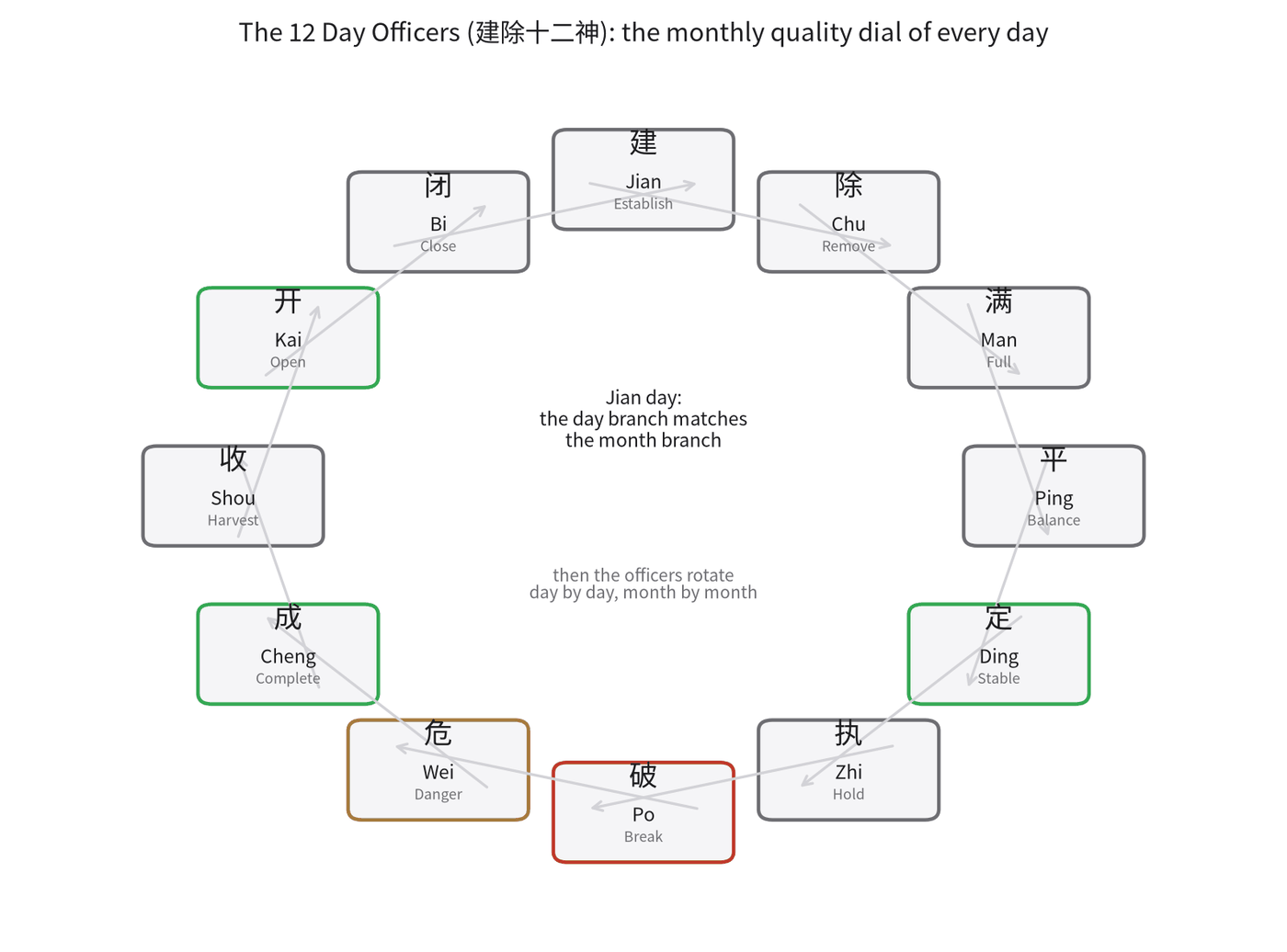
The operational philosophy of the 12 Day Officers is captured in the classical treatise Dong Gong Ze Ri (董公择日):
Chinese Original: 建日不宜用药,除日服药大吉。破日百事忌用,成日凡事皆成。
English Translation: On an Establish (Jian) day, it is unsuitable to take medicine or start treatments; on a Removal (Chu) day, taking medicine brings great good fortune. On a Destruction (Po) day, all important affairs are strictly forbidden; on a Success (Cheng) day, all endeavors come to fruition.
Attribution: Dong Gong Ze Ri (董公择日), Classical Treatise on Auspicious Timing
Let us examine the specific mechanics, optimal applications, dangerous misapplications, and practical commentary for each of the Twelve Day Officers in detail:
1. Jian (建 – Establish Day)
Energy Quality: Dense, dominant, foundational, and executive.
Optimal Favorable Activities: Strategic executive planning, hiring senior leadership, submitting official proposals, commencing administrative setup, and assuming public office.
Unfavorable Forbidden Activities: Weddings, retail storefront launches, soft commercial negotiations, and ground-breaking burials.
Tactical Commentary: Jian sets the baseline tone for an entire cycle. It carries high authority but lacks soft flexibility. Use it when you need to assert top-down administrative dominance, but avoid it for events requiring diplomatic compromise or emotional warmth.
2. Chu (除 – Remove Day)
Energy Quality: Cleansing, purging, subtractive, and liberating.
Optimal Favorable Activities: Medical surgical procedures, initiating detox diets, settling outstanding debts, firing underperforming staff, terminating toxic contracts, and deep cleaning physical spaces.
Unfavorable Forbidden Activities: Weddings, contract signing, business launches, and adopting pets.
Tactical Commentary: Chu is a master purging day. It excels at eliminating drag, clearing systemic blockages, and ending negative cycles. Trying to start a marriage or launch an e-commerce platform on a Chu day causes the initiative to dissolve quickly.
3. Man (满 – Full Day)
Energy Quality: Abundant, overflowing, peaked, and accumulating.
Optimal Favorable Activities: Hosting reward banquets, collecting outstanding receivables, launching promotional drives, opening savings accounts, and installing wealth features.
Unfavorable Forbidden Activities: Medical surgeries, excavating foundations, firing employees, and legal debt disputes.
Tactical Commentary: Man represents peak capacity. Whatever you do on a Man day will be magnified and filled to the brim. If you host a celebration, joy overflows; if you undergo surgery, swelling and fluids overflow. Use it exclusively for positive accumulation.
4. Ping (平 – Balance Day)
Energy Quality: Smooth, equalizing, neutral, and stabilizing.
Optimal Favorable Activities: Dispute mediation, contract re-negotiation, structural road repairs, balancing corporate books, and leveling physical land.
Unfavorable Forbidden Activities: Aggressive market expansion, high-stakes litigation, and launching competitive takeovers.
Tactical Commentary: Ping smooths out rough edges and brings opposing sides into equilibrium. It is the premier officer for reaching fair compromises, but it lacks the explosive upward thrust needed for aggressive commercial expansion.
5. Ding (定 – Settle Day)
Energy Quality: Grounded, fixed, permanent, and binding.
Optimal Favorable Activities: Signing long-term commercial leases, securing marriage licenses, formalizing long-term partnerships, and placing foundational stones.
Unfavorable Forbidden Activities: Moving house, commencing fast-paced travel, launching temporary flash marketing campaigns, and filing lawsuits.
Tactical Commentary: Ding locks commitments into stone. It creates deep structural stability and prevents future mind-changing. Do not use Ding for agile, temporary initiatives that require future flexibility.
6. Zhi (执 – Hold Day)
Energy Quality: Enforcing, defensive, holding, and retaining.
Optimal Favorable Activities: Formalizing legal contracts, hiring security personnel, planting long-term crops, capturing assets, and enforcing policies.
Unfavorable Forbidden Activities: Moving house, embarking on long-distance travel, breaking up partnerships, and initiating restructuring.
Tactical Commentary: Zhi clings tightly to the current status quo. It is excellent for asset retention, security implementation, and operational defense, but poor for breaking away from existing constraints.
7. Po (破 – Destruction Day)
Energy Quality: Volatile, fragmented, disruptive, and explosive.
Optimal Favorable Activities: Physical demolition of old buildings, breaking down structural walls, terminating abusive relationships, and dismantling corrupt systems.
Unfavorable Forbidden Activities: Weddings, commercial launches, contract signing, financial investments, and medical treatments.
Tactical Commentary: Po carries severe clash energy. It shatters structure. While highly effective for physical demolition or tearing down broken infrastructure, using a Po day for constructive endeavors leads to emotional strife, legal conflict, and financial devastation.
8. Wei (危 – Danger Day)
Energy Quality: Precarious, high-risk, volatile, and delicate.
Optimal Favorable Activities: High-risk strategic positioning, religious protection rituals, internal safety audits, and emergency contingency planning.
Unfavorable Forbidden Activities: Extreme sports, high-altitude construction, long-distance maritime travel, and formal weddings.
Tactical Commentary: Wei places you on a high tightrope. While skilled risk-takers can occasionally leverage Wei energy for sudden strategic repositioning, the margin for error is razor-thin. Beginners should avoid Wei days for critical personal milestones.
9. Cheng (成 – Success Day)
Energy Quality: Auspicious, fruitful, victorious, and harmonizing.
Optimal Favorable Activities: Grand openings, commercial product launches, weddings, contract executions, commencing construction, and major financial investments.
Unfavorable Forbidden Activities: Initiating lawsuits, entering legal disputes, and administrative debt collection.
Tactical Commentary: Cheng is widely considered the king of growth officers. It yields positive compound results and ensures that efforts come to fruitful completion. Note that whatever you start on Cheng succeeds; if you start a lawsuit on Cheng, the legal battle itself will succeed and prolong indefinitely.
10. Shou (收 – Receive Day)
Energy Quality: Harvesting, gathering, securing, and retaining.
Optimal Favorable Activities: Collecting payments, harvesting crops, closing sales deals, asking for raises, adopting pets, and securing intellectual property.
Unfavorable Forbidden Activities: Medical treatment, attending funerals, visiting sick patients, and initiating legal action.
Tactical Commentary: Shou focuses on pulling value inward. It is an exceptional day for sales professionals closing deals or business owners collecting late receivables. Avoid using Shou when you are attempting to project outward or release negative burdens.
11. Kai (开 – Open Day)
Energy Quality: Expansive, welcoming, illuminating, and unblocking.
Optimal Favorable Activities: Storefront grand openings, digital platform deployment, public relations announcements, commencing higher education, and starting new jobs.
Unfavorable Forbidden Activities: Funeral burials, ground excavations, and confidential secret operations.
Tactical Commentary: Kai opens pathways and invites massive public visibility. It is the absolute top choice for retail openings, marketing blitzes, and public announcements where broad reach and foot traffic are paramount.
12. Bi (闭 – Close Day)
Energy Quality: Sealed, dormant, inward, and restrictive.
Optimal Favorable Activities: Building personal savings, closing accounting books, private meditation retreats, sealing tombs, and installing high-security vaults.
Unfavorable Forbidden Activities: Storefront grand openings, public marketing launches, weddings, and medical treatments.
Tactical Commentary: Bi represents sealed, dormant energy. It freezes movement and blocks public interaction. Attempting to launch a business or host a public event on a Bi day results in zero foot traffic, poor reach, and deep operational stagnation.
Table 2: Master Reference Table of the 12 Day Officers
| Officer Name | Chinese Character | General Energy Quality | Optimal Favorable Activities | Unfavorable Forbidden Activities | Strategic Tactical Commentary |
|---|---|---|---|---|---|
| Jian | 建 (Establish) | Dense, Dominant, Inception | Executive planning, hiring leaders, starting strategy | Weddings, retail launches, soft negotiations | Sets the baseline tone; powerful for authority, poor for consensus. |
| Chu | 除 (Remove) | Cleansing, Purging, Clearing | Medical surgery, debt settlement, firing staff, cleaning | Weddings, contract signing, business launches | Subtractive energy; excellent for shedding weight or ending friction. |
| Man | 满 (Full) | Abundant, Overflowing, Peak | Promotions, debt collection, banquets, wealth setup | Medical procedures, digging foundations, burials | High accumulation; use when you want maximum density and harvest. |
| Ping | 平 (Balance) | Neutral, Equalizing, Smooth | Dispute mediation, contract negotiation, road repair | Aggressive expansion, high-stakes litigation | Smooths rough edges; ideal for reaching equitable compromise. |
| Ding | 定 (Settle) | Permanent, Grounded, Fixed | Signing long leases, marriage licenses, partnership deals | Moving house, long travel, temporary marketing | Locks commitments into stone; exceptional for long-term stability. |
| Zhi | 执 (Hold) | Enforcing, Holding, Securing | Contract signing, hiring security, planting, capturing | Moving house, long travel, breaking partnerships | Clings tightly to current state; good for retention and defense. |
| Po | 破 (Destruction) | Volatile, Fragmented, Clashing | Physical demolition, tearing down structures, ending ties | Weddings, contract signing, commercial launches | Severe seasonal clash; shatters structures and creates conflict. |
| Wei | 危 (Danger) | Precarious, High-Risk, Unstable | High-risk positioning, safety audits, protection rituals | Extreme sports, high construction, travel, weddings | Tightrope energy; high risk with narrow upside for general events. |
| Cheng | 成 (Success) | Auspicious, Victorious, Compound | Grand openings, weddings, contract signing, launching | Initiating lawsuits, debt collection, dispute filing | Premier growth officer; yields positive compound completion. |
| Shou | 收 (Receive) | Harvesting, Gathering, Inward | Closing sales, collecting debts, asking for raises | Funerals, medical treatments, filing lawsuits | Pulls value inward; great for collection, poor for outward push. |
| Kai | 开 (Open) | Expansive, Welcoming, Unblocking | Store openings, platform deployments, PR releases | Funerals, secret operations, ground digging | Opens pathways; premier officer for public reach and walk-ins. |
| Bi | 闭 (Close) | Sealed, Dormant, Inward | Vault installation, private retreats, closing books | Grand openings, public launches, weddings | Seals energy inward; creates stagnation and blocks public reach. |
5. Secondary Variables: Shen Sha, Solar Extremes, and Energy Transition Days
Think of date selection like filtering coffee through a multi-stage process. Personal clashes and Day Officers remove the heavy grounds; secondary symbolic stars and astronomical boundary days perform the fine particulate filtering.
The classical framework introduces secondary symbolic stars known collectively as Shen Sha (神煞). While novice practitioners often obsess over these stars and freeze in over-analysis, professional practitioners view them as fine-tuning variables. Shen Sha fall into two general categories: Positive Auspicious Stars (Ji Shen 吉神) and Negative Sha Stars (Xiong Shen 凶神).
Among the positive stars, the two most influential are Tian Yi Nobleman (天乙贵人) and the Two Virtues: Heavenly Virtue (Tian De 天德) and Monthly Virtue (Yue De 月德). When a date features Tian Yi Nobleman, helpful mentors, supportive investors, and noble patrons tend to step forward to resolve unexpected complications. When a date features Tian De or Yue De, the ambient Qi carries a powerful protective shield that neutralizes minor negative influences and fosters goodwill.
Among the negative Sha stars, the primary ones to watch are Red Phoenix (Zhu Que 朱雀), Year Sha (岁煞), and Robbery Sha (Jie Sha 劫煞). Zhu Que activates public arguments, verbal disputes, and PR friction; executing a contract or wedding on a Zhu Que day guarantees heated arguments. Year Sha creates operational delays and sluggish stagnation. Robbery Sha introduces unexpected monetary leaks, theft, or sudden unexpected expenses.
In addition to Shen Sha, every practitioner must strictly enforce the rules governing astronomical boundary days: the Four Separation Days (Si Li 四离) and Four Extinction Days (Si Jue 四绝). These represent critical solar nodes where seasonal energy undergoes violent transitions.
The Four Separation Days (Si Li) occur on the exact days preceding the Vernal Equinox, Autumnal Equinox, Summer Solstice, and Winter Solstice. On these days, the prevailing seasonal Qi splits and separates, creating profound imbalance between Yin and Yang elements. The Four Extinction Days (Si Jue) occur on the exact days preceding the Start of Spring (Li Chun), Start of Summer (Li Xia), Start of Autumn (Li Qiu), and Start of Winter (Li Dong). On these days, the outgoing element is completely exhausted before the incoming element takes root.
Attempting to launch a business, sign a partnership, or celebrate a wedding on a Si Li or Si Jue day is like building a house on shifting tectonic plates. The ambient energy is dead, exhausted, and turbulent. Major life milestones should never occur on these transition boundary days.
To keep your analytical process clean and logical, follow this strict priority ladder when filtering potential dates:
- First Filter (Non-Negotiable Veto): Check for Personal Day Branch Clashes (Ri Chong) and Sui Po (Year Clash). If a clash exists, eliminate the date instantly.
- Second Filter (Astronomical Veto): Check whether the date falls on a Si Li (Four Separation) or Si Jue (Four Extinction) day. If so, eliminate the date instantly.
- Third Filter (Cyclical Alignment): Evaluate the 12 Day Officers. Select growth officers (Cheng, Kai, Man, Ding) for expansion, or purging officers (Chu) for cleanup. Eliminate Po, Bi, and Wei days for major positive initiatives.
- Fourth Filter (Fine-Tuning Refinement): Check Shen Sha symbolic stars. Prioritize dates with Nobleman and Virtue stars while avoiding severe Sha stars like Zhu Que or Robbery Sha.
6. Precision Hourly Execution: Integrating Qi Men Dun Jia (奇门遁甲)
You spent three weeks selecting a macro date with an outstanding Success Day Officer, zero personal clashes, and glowing virtue stars. You invited the media, booked the venue, and pressed the official launch button at 10:15 AM. Within twenty minutes, your primary payment gateway crashes, your hosting provider suffers an unannounced outage, and your founder’s mobile phone drops into a storm drain. What went wrong? You selected a golden day but executed it during a hostile double-hour window.
A macro day consists of twelve double-hour periods (Shi Chen 时辰), each governed by its own Earthly Branch. Just as a day can clash with your personal birth chart, an hour can clash with the macro day branch or your personal chart. Executing a critical task during a clashing hour introduces immediate operational chaos into an otherwise pristine day.
To achieve absolute surgical precision, high-level practitioners layer the ancient tactical art of Qi Men Dun Jia (奇门遁甲) onto the chosen double-hour window. Qi Men Dun Jia splits time and space into nine distinct energetic palaces, analyzing the dynamic movement of Stems, Doors, and Stars.
When selecting an execution hour using Qi Men Dun Jia, practitioners focus on three core components:
1. The Three Mystics (San Qi 三奇)
The Three Mystics represent the most refined Heavenly Stems in the Qi Men chart: Yi Mystic (乙奇 – Sun Mystic / Adaptive Strategy), Bing Mystic (丙奇 – Moon Mystic / Public Brilliance & Authority), and Ding Mystic (丁奇 – Star Mystic / Precision Execution & Technological Clarity). Locating a double-hour where a Mystic lands in your active palace provides powerful intellectual clarity and protection.
2. The Three Auspicious Doors (San Ji Men 三吉门)
The eight doors of Qi Men Dun Jia govern human activity and operational direction. The three auspicious doors are Kai Men (开门 – Open Door), which governs commercial grand openings, public expansion, and administrative career moves; Sheng Men (生门 – Life/Growth Door), which governs capital investment, profit generation, real estate, and wealth creation; and Xiu Men (休门 – Rest Door), which governs negotiations, diplomatic reconciliations, and family harmony.
3. Avoiding Voidness (Kong Wang 空亡) and Structure Clashes
Even an auspicious door loses its potency if it falls into Voidness (Kong Wang), which signifies empty, unfulfilled energy where efforts yield zero tangible return. Furthermore, practitioners verify that the hour chart does not contain structural clashes, such as Kan-Li water-fire clashes or Metal-Wood structural ruptures.
7. Worked Example 1: Selecting an Auspicious Business Launch Date
When my good friend Min Hui walked into my office asking for a launch date for her Jurong dessert cafe, she brought a spreadsheet loaded with construction deadlines and a complete lack of temporal strategy. Let us examine how we built her launch timeline step by step. (This scenario uses constructed, clearly labeled teaching data designed to illustrate the exact analytical protocol).
Client Profile & Operational Objective (Teaching Case):
Entity Type: Min Hui is opening an artisanal dessert cafe in Jurong while simultaneously deploying a nationwide e-commerce delivery platform.
Primary Founder Birth Data: Min Hui was born in a Bing-Chen (丙辰) Year, on a Ren-Wu (壬午) Day.
Key Personal Branch: Min Hui’s personal Day Branch is Wu (午 – Horse). Direct Clash Branch: Zi (子 – Rat).
Target Launch Window: Early October 2026 (governed by the Solar Dog Month, Xu 戌 month).
Strategic Requirement: Min Hui requires a high-visibility, high-conversion launch date that maximizes walk-in traffic, secures financial stability, and avoids operational friction.
Step 1: Identifying Personal Elimination Criteria
Because Min Hui’s personal Day Branch is Wu (Horse), any day governed by the Zi (Rat) branch represents a direct Personal Day Clash (Zi-Wu Clash). Zi days are strictly forbidden for Min Hui, regardless of general calendar listings or general almanac ratings.
Step 2: Evaluating Candidate Dates
Min Hui presents three candidate launch dates within her target operational window in October 2026:
Analysis of Candidate Date A (October 6, 2026 – Bing-Zi Day / 丙子日)
Stem/Branch: Bing-Zi (丙子). Day Branch is Zi (Rat).
Day Officer: Bi (闭 – Close Day).
Personal Clash Status: Zi directly clashes with Min Hui’s personal Wu Day Branch (Zi-Wu Clash). FATAL PERSONAL CLASH.
Day Officer Status: Bi (Close) represents dormant, sealed, inward energy, completely unsuitable for a retail grand opening or digital deployment.
Verdict: REJECTED. A direct personal clash combined with a Close Day Officer makes this date disastrous. Launching on this day would cause server crashes, minimal foot traffic, and founder burnout.
Analysis of Candidate Date B (October 9, 2026 – Ji-Mao Day / 己卯日)
Stem/Branch: Ji-Mao (己卯). Day Branch is Mao (Rabbit).
Day Officer: Po (破 – Destruction Day).
Personal Clash Status: Mao does not clash with Min Hui’s Wu branch (no direct personal clash).
Month Clash Status: During the Dog month (Xu 戌), Mao forms a Six Harmony with Xu. However, the day officer calculation designates this day as Po (Destruction).
Auxiliary Star Note: Features Zhu Que (Red Phoenix), indicating high risk of public relations conflict, customer disputes, and bad online reviews.
Verdict: REJECTED. Even without a direct personal clash, a Po (Destruction) day carries clashing seasonal energy that shatters commercial creation.
Analysis of Candidate Date C (October 12, 2026 – Ren-Wu Day / 壬午日)
Stem/Branch: Ren-Wu (壬午). Day Branch is Wu (Horse).
Day Officer: Cheng (成 – Success Day).
Personal Clash Status: Wu matches Min Hui’s Day Branch (Wu-Wu Fu Yin / Self-Branch). There is zero direct clash (Zi is absent).
Day Officer Status: Cheng (Success) is the premier officer for commercial grand openings, public visibility, and commercial transactions.
Auxiliary Stars: Features Tian De (Heavenly Virtue) and Yue De (Monthly Virtue) stars, providing strong protective energy and attracting noble patrons.
Verdict: SELECTED PREFERRED DATE. Outstanding Day Officer (Cheng), powerful virtue stars, zero direct clash.
Table 3: Business Launch Candidate Date Comparison Table (Teaching Case)
| Candidate Date | Day Stem & Branch | Day Officer | Personal Clash Check (Wu Branch) | General Qi & Shen Sha Stars | Final Selection Verdict |
|---|---|---|---|---|---|
| Date A: Oct 6, 2026 | Bing-Zi (丙子) | Bi (闭 – Close) | DIRECT PERSONAL CLASH (Zi-Wu) | Sealed Qi, Inactive, High Friction | REJECTED (Fatal Personal Clash) |
| Date B: Oct 9, 2026 | Ji-Mao (己卯) | Po (破 – Destruction) | No Clash (Mao-Wu Harmony) | Destructive Qi, Zhu Que Red Phoenix Star | REJECTED (Severe Seasonal Clash) |
| Date C: Oct 12, 2026 | Ren-Wu (壬午) | Cheng (成 – Success) | No Clash (Self-Branch Wu) | Tian De & Yue De Virtues, Victorious Qi | ACCEPTED (Optimal Commercial Window) |
Step 3: Hourly Precision Execution using Qi Men Dun Jia
Having selected October 12, 2026 (Ren-Wu Day) as the macro date, we must pinpoint the optimal double-hour window for pushing the live digital portal button and cutting the ribbon at the Jurong cafe.
Evaluating double-hour windows on October 12, 2026:
Zi Hour (11:00 PM – 1:00 AM): Clashes with the day branch (Wu-Zi hour clash). Rejected.
Si Hour (9:00 AM – 11:00 AM): Features the Si Shen (巳时) chart. In the Qi Men Dun Jia chart for this day, the Southeast Palace (Sun Palace) contains Kai Men (开门 – Open Door) paired with the Ding Mystic (丁奇) and the Tian Fu Star (天辅星 – Cultural/Academic Star).
Execution Mandate: Min Hui is instructed to cut the inaugural ribbon at her Jurong cafe and trigger the online e-commerce platform deployment precisely at 09:38 AM (Si Hour), capitalizing on the open pathways and technological clarity of the Open Door and Ding Mystic.
8. Worked Example 2: Selecting an Auspicious Wedding Date
Wedding date selection is where family elders fight, venue managers lose their minds, and professional practitioners earn their keep. Let us return to Marcus and Chloe, the couple whose Auntie May caused a family uproar in our opening scene. (This scenario uses constructed, clearly labeled teaching data designed to illustrate the exact analytical protocol).
Client Profile & Operational Objective (Teaching Case):
Groom Birth Data (Marcus): Born on a Geng-Shen (庚申) Day. Groom’s Day Branch is Shen (申 – Monkey). Groom’s direct personal clash branch is Yin (寅 – Tiger).
Bride Birth Data (Chloe): Born on an Yi-Mao (乙卯) Day. Bride’s Day Branch is Mao (卯 – Rabbit). Bride’s direct personal clash branch is You (酉 – Rooster).
Target Marriage Window: Mid-November 2026 (governed by the Solar Pig Month, Hai 亥 month).
Special Marriage Requirements:
1. The date must NOT clash with the Groom’s Day Branch (Yin days forbidden).
2. The date must NOT clash with the Bride’s Day Branch (You days forbidden).
3. The date should feature a Ding (Settle), Cheng (Success), or Man (Full) Day Officer.
4. The date must avoid Red Phoenix (Zhu Que), Year Sha, and Solstice/Equinox transition days.
Evaluating Candidate Dates
Marcus and Chloe present three candidate wedding dates in mid-November 2026:
Analysis of Candidate Date A (November 14, 2026 – Bing-Yin Day / 丙寅日)
Stem/Branch: Bing-Yin (丙寅). Day Branch is Yin (Tiger).
Day Officer: Zhi (执 – Hold Day).
Groom Clash Check: Yin directly clashes with Marcus’s Shen branch (Yin-Shen Clash). FATAL GROOM CLASH.
Bride Clash Check: Yin does not clash with Chloe’s Mao branch.
Verdict: REJECTED. Direct clash with the groom’s personal pillar. Marrying on this day creates immediate friction, travel hazards, and instability for the husband.
Analysis of Candidate Date B (November 18, 2026 – Geng-You Day / 庚酉日)
Stem/Branch: Geng-You (庚酉). Day Branch is You (Rooster).
Day Officer: Po (破 – Destruction Day).
Groom Clash Check: You does not clash with Marcus’s Shen branch.
Bride Clash Check: You directly clashes with Chloe’s Mao branch (Mao-You Clash). FATAL BRIDE CLASH.
Day Officer Status: Po (Destruction) day carries fragmented, clashing seasonal energy.
Verdict: REJECTED. Fatal clash with the bride’s personal pillar combined with a destructive Day Officer. Marrying on this day leads to severe emotional strife and high divorce risk.
Analysis of Candidate Date C (November 21, 2026 – Gui-Hai Day / 癸亥日)
Stem/Branch: Gui-Hai (癸亥). Day Branch is Hai (Pig).
Day Officer: Ding (定 – Settle / Stable Day).
Groom Clash Check: Hai does not clash with Marcus’s Shen branch (Hai forms a supportive water combination with Shen).
Bride Clash Check: Hai forms a powerful Six Harmony with Chloe’s Mao branch (Hai-Mao Wood Harmony).
Day Officer Status: Ding (Settle) is one of the premier officers for marital commitment, fixing bonds permanently.
Auxiliary Stars: Features Tian Yi Nobleman (天乙贵人) and Red Matchmaker Star (Hong Luan 红鸾), fostering deep affection and family harmony.
Verdict: SELECTED PREFERRED DATE. Zero clashes for both parties, powerful Six Harmony for the bride, excellent Ding Day Officer, supreme marital stars.
Table 4: Wedding Candidate Date Comparison Table (Teaching Case)
| Candidate Date | Day Stem & Branch | Day Officer | Groom Clash Check (Shen Branch) | Bride Clash Check (Mao Branch) | Final Selection Verdict |
|---|---|---|---|---|---|
| Date A: Nov 14, 2026 | Bing-Yin (丙寅) | Zhi (执 – Hold) | DIRECT CLASH (Yin-Shen) | No Clash | REJECTED (Groom Personal Clash) |
| Date B: Nov 18, 2026 | Geng-You (庚酉) | Po (破 – Destruction) | No Clash | DIRECT CLASH (Mao-You) | REJECTED (Bride Clash & Po Day) |
| Date C: Nov 21, 2026 | Gui-Hai (癸亥) | Ding (定 – Settle) | No Clash (Supportive Qi) | SIX HARMONY (Hai-Mao) | ACCEPTED (Perfect Marital Alignment) |
The imperative to select non-clashing, harmonic dates for marriage is echoed emphatically in the classical treatise Xie Ji Bian Fang Shu:
Chinese Original: 岁煞月煞,日之忌也。冲者,干支相对,气不相和,故凡造作婚姻开市,皆宜避之。
English Translation: Year Sha and Month Sha are the primary prohibitions of a date. A clash occurs when Heavenly Stems or Earthly Branches stand in direct opposition, causing the Qi to become disharmonious; therefore, construction, marriage, and business launches should all avoid them.
Attribution: Xie Ji Bian Fang Shu (协纪辨方书), Imperial Qing Dynasty Treatise on Calendar Selection, Volume 3
Optimal Hour Selection for Ceremony Execution
For November 21, 2026 (Gui-Hai Day), the tea ceremony and vow exchanges are scheduled during the Wei Hour (01:00 PM – 03:00 PM). The Wei Hour completes a full Three Harmony Wood Triad (Hai-Mao-Wei 亥卯未) between the Day Branch (Hai), Bride’s Branch (Mao), and Hour Branch (Wei). The couple is instructed to sign their marriage documents precisely at 01:28 PM during the Wei hour, sealing their union under optimal harmonic conditions.
9. Common Mistakes and Misconceptions in Modern Date Selection
Over fifteen years of auditing date selections, I have seen every imaginable blunder. Founders spend tens of thousands of dollars fixing commercial launch disasters that five minutes with a proper calendar could have prevented. Below are six of the most prevalent mistakes observed in modern practice, along with technical corrections.
Mistake 1: Relying Exclusively on Generic Lunar Numbers
A widespread commercial myth assumes that dates ending in 8, 18, or 28 are automatically lucky, while dates ending in 4 are unlucky. This is superficial linguistic wordplay based on Cantonese pronunciation homophones (8 sounds like wealth; 4 sounds like death). Classical Ze Ri operates on Stem-Branch cyclical interactions, astronomical solar terms, and personal BaZi alignment. An 8th day that directly clashes with your personal Day Branch is toxic, while a 4th day featuring a Success Officer and Six Harmony is outstanding.
Mistake 2: Ignoring Personal BaZi Day Branches
Many people open a generic wall calendar, see a date marked auspicious, and schedule their contract signing without checking their personal birth chart. An almanac listing is generic; it calculates general daily quality for the global population. It cannot account for your personal birth pillar. If the general almanac lists a date as auspicious, but that date clashes with your personal Day Branch, the date is hostile for you.
Mistake 3: Over-Analysis Paralysis from Minor Auxiliary Stars
Beginners frequently panic when they see a minor negative star (such as Solitary Star or Small Leak) listed on an otherwise pristine date. They end up rejecting dozens of excellent windows while waiting for a mythical perfect day that contains zero minor negative stars. In classical date selection, macro alignment (no personal clash, no Sui Po, no Si Li/Si Jue) combined with an auspicious Day Officer (Cheng, Kai, Man, Ding) carries ninety percent of the weight. Minor stars provide fine nuance and should never veto a strong macro day.
Mistake 4: Using Po (Destruction) or Bi (Close) Days for Expansion Initiatives
Entrepreneurs frequently schedule grand openings or digital product deployments on Po or Bi days simply because those dates fit their internal operational sprints. Launching on a Po day shatters early traction, generating bugs and conflict; launching on a Bi day seals off public visibility, resulting in zero walk-in traffic or download traction.
Mistake 5: Perfect Macro Day Ruined by a Clashing Hour
A client selects an outstanding Success day with zero personal clashes, but schedules their official signing ceremony during an hour that directly clashes with the day branch or their personal pillar. The resulting friction causes late arrivals, misplaced legal documents, and immediate miscommunication.
Mistake 6: Confusing Superstition with Pattern Recognition
Skeptics often dismiss date selection as mystical nonsense, assuming it claims to magically alter reality. Professional Ze Ri is applied temporal pattern recognition. It does not replace sound strategy, excellent product development, or personal effort. It optimizes execution timing, ensuring that your strategic labor meets supportive environmental currents.
10. Practical Verification and Self-Test Exercises for Students
Theory without practical execution is intellectual wallpaper. To solidify your technical understanding of classical date selection, work through the practical exercises and self-test scenarios detailed below.
Practical Exercise 1: Personal Clash Mapping
Calculate your personal Day Master and Day Branch using a reliable BaZi calendar tool. Identify your direct clash branch from Table 1. Open a standard Chinese solar calendar for the upcoming month and mark every day governed by your clash branch. These represent your personal blackout dates for the month. Practicing this monthly mapping builds an automatic habit of personal risk management.
Practical Exercise 2: Auditing Historical Personal Events
Select three major past events from your life: one highly successful milestone (such as a smooth product launch or successful property move), one highly disruptive or stressful event, and your wedding date. Look up the Stem-Branch pillars and Day Officers for those historical dates. Evaluate whether the historical outcomes align with the daily Qi conditions (for example, did the disruptive event occur on a personal clash or Po day?). Auditing historical data provides personal empirical verification of cyclical temporal patterns.
Self-Test Scenarios & Explanations
Scenario 1
Question: An entrepreneur whose Day Branch is You (Rooster) plans to sign a multi-million dollar partnership contract. The calendar shows a date governed by the Mao (Rabbit) branch with a Cheng (Success) Day Officer. Should this entrepreneur proceed on this date?
Answer & Explanation: REJECT THE DATE. Even though Cheng (Success) is generally an outstanding officer, the Mao branch directly clashes with the founder’s You Day Branch (Mao-You Clash). Rule 1 (Personal Clash Elimination) strictly overrides Rule 3 (Day Officer Selection). Proceeding on this date would lead to legal disputes, partnership breakdown, or contract breaches later on.
Scenario 2
Question: A company needs to fire a dishonest executive and clear out corrupted server logs. Which Day Officer is most structurally aligned for this specific action: Cheng (Success), Chu (Remove), or Kai (Open)?
Answer & Explanation: CHU (REMOVE) DAY OFFICER. While Cheng and Kai are positive for growth and expansion, Chu (Remove) specializes in purging negativity, firing underperformers, ending toxic ties, and cleansing systems. Using a Chu day ensures clean separation with minimal legal tail risks.
Scenario 3
Question: A couple plans to get married on the day immediately preceding the Start of Spring (Li Chun). The calendar shows a Kai (Open) Day Officer with no personal clashes. Is this date suitable?
Answer & Explanation: REJECT THE DATE. The day immediately before Li Chun is a Si Jue (Four Extinction) Day, marking the complete exhaustion of Winter Water Qi before Spring Wood takes over. Major life milestones like weddings should never occur on Si Li or Si Jue days because the seasonal energy is dying and unstable.
Scenario 4
Question: A retail store owner wants to host a ribbon-cutting grand opening. The calendar offers two potential days: Day X is a Ding (Settle) day, while Day Y is a Kai (Open) day. Neither day clashes with the owner’s chart. Which date is better for a retail store opening?
Answer & Explanation: DAY Y (KAI / OPEN DAY). Kai represents expanding pathways, public exposure, and foot traffic, making it ideal for retail openings. Ding (Settle) is great for long leases and stability, but its Qi is fixed and static, generating lower walk-in momentum than Kai.
Scenario 5
Question: When selecting a specific double-hour window for a business launch using Qi Men Dun Jia, which combination of Door and Mystic represents maximum public impact and technological clarity?
Answer & Explanation: The combination of Kai Men (Open Door) with the Bing Mystic (丙奇 – Moon Mystic / Public Brilliance) or Ding Mystic (丁奇 – Star Mystic / Precise Execution). This pairing creates high public visibility, positive reception, and seamless technological execution.
11. Frequently Asked Questions (FAQ)
Q1: How do timezones affect date selection for global online launches?
When launching a digital product or service accessible worldwide, date selection should be calculated based on the local solar time of the physical location where the core server trigger is activated or where the founder and key decision-makers are physically present during execution. The human intention and physical action anchor the energetic timing.
Q2: What if no ideal dates exist within a tight operational deadline?
In fast-paced business environments, waiting three months for a perfect date is not always feasible. If no ideal dates are available within your target window, prioritize risk elimination above all else: eliminate personal clash days, Sui Po days, and Po days. Selecting a neutral day (such as Ping / Balance) with zero clashes is far better than forcing an action on a destructive clash day.
Q3: Can a good date overcome bad business strategy or a poor product?
No. Date selection is an operational multiplier, not a magic substitute for competence. A flawless date cannot save a terrible product, an incompetent team, or an unviable business model. Strategic capability (Man) and sound execution remain foundational. Proper timing (Heaven) ensures that your hard work achieves maximum yield without temporal drag.
Q4: What is the structural difference between a generic Tong Sheng almanac and professional date selection?
A commercial Tong Sheng (Chinese Almanac) provides broad, general daily quality ratings calculated for the general population. Professional date selection layers your personal BaZi birth chart, specific functional objectives (business vs marriage vs surgery), and hourly Qi Men Dun Jia charts onto the date, creating a personalized temporal map.
Q5: What should a couple do if family elders demand a wedding date that clashes with their BaZi charts?
This is a frequent diplomatic challenge. Family elders often rely on generic lunar dates or basic popular almanacs. In such cases, present two or three alternative candidate dates that satisfy the elders’ general preferences while remaining strictly non-clashing for the couple’s personal Day Branches. Professional practitioners frequently act as neutral mediators to guide families toward genuine alignment.
12. Cultivating Temporal Wisdom in Modern Life
If you leave this field manual with only one core realization, let it be this: time is not an enemy to be rushed or an empty grid of appointments, but a powerful strategic weapon. In a modern culture obsessed with frantic hurry, reactive urgency, and forcing immediate outcomes, classical date selection teaches us to pause, observe natural cycles, and act with deliberate alignment.
When you align your actions with the natural currents of time, you stop swimming against the tide. You begin to experience a state of effortless flow where obstacles resolve naturally, strategic partnerships click into place, and hard work yields its full potential. Master the foundational rules, eliminate destructive clashes, respect the 12 Day Officers, and execute with precision. The calendar is no longer a passive wall hanging, but a strategic blueprint for long-term mastery.
Where to go next
Date selection quietly assumes you know whose chart the date must serve: The Day Master Files covers that foundation. For the other great oracle of yes and no, see the practitioner’s manual for reading the I Ching. And when the question is not when but where, the anatomy of a classical feng shui audit picks up where the calendar ends. The QMDJ-specific method has its own page: date selection using Qi Men Dun Jia.
Leave a Reply
You must be logged in to post a comment.