
Inside a Residential Feng Shui Consultation
Standing outside the main entrance of Mr and Mrs Teo’s condominium block in Bukit Timah, I set my feet shoulder-width apart, unclip the heavy wooden base of my Luopan, and look up. Before I even glance at the needle resting in the central Heaven Pool, the building has already revealed its secrets. The ten-story residential tower behind us rises tall and firm, giving solid backing support. But thirty yards to the east, an elevated concrete drainage canal cuts sharply past the driveway, sweeping water rapidly away from the main foyer. In classical terms, the dragon is present, but the water current is hurried and harsh. That single ten-second observation tells me more about why the couple has experienced sudden financial volatility over the past eighteen months than any glossy sales brochure ever could.
When most people picture a feng shui audit, they imagine a soft-spoken mystic wandering through room after room with a bundle of burning sage, chanting softly and recommending brass trinkets for every corner. The reality of classical audit work is far closer to architectural diagnostics and environmental physics. It involves precise compass bearings, topographic analysis, structural geometry, and time-based matrix mathematics. The consultant who promises to fix your marriage with a water fountain is not selling feng shui, he is selling hope with a receipt.
A legitimate consultation is a systematic physical and mathematical assessment of how a building collects, retains, and distributes environmental energy (Qi). Environmental forces affect human health, mental focus, emotional stability, and financial decision-making over time. To understand how a practitioner evaluates a property, we must step past the myths and examine every stage of an on-site audit from the moment a floor plan lands on a desk to the six-month post-audit follow-up review.
The Theoretical Foundation: The Four Major Schools of Classical Feng Shui
If you ask four different feng shui consultants why your home office makes you feel exhausted by three in the afternoon, you might get four different answers. If those practitioners actually know their craft, all four answers will fit together like individual tumblers inside a single brass lock. Classical feng shui is not a monolithic set of arbitrary superstitions. It is an umbrella system containing four primary analytical methodologies, each examining environmental energy from a distinct vantage point.
Understanding these four major schools allows property owners to distinguish between genuine environmental analysis and modern commercial invention. Let us examine how each classical school functions during a residential audit.
1. Form School (Luan Tou / Luan Sheng)
Form School is the bedrock of all classical feng shui practice. Long before compasses were invented, ancient observers analyzed the physical landscape to locate safe, fertile settlements. Form School focuses entirely on tangible landforms: mountain contours, rock formations, river curves, soil quality, elevation shifts, and the structural geometry of nearby buildings.
In classical theory, Qi flows along mountain ridges and collects near body boundaries where land meets water. As the ancient classic states:
“气乘风则散,界水则止。古人聚之使不散,行之使有止,故谓之风水。”
(Guo Pu, Zang Shu / Book of Burial)
Translated into plain terms: “Qi rides the wind and scatters; it stops at the boundary of water. The ancients gathered it so it would not scatter, and guided it so it would halt. Hence it is called Feng Shui (Wind-Water).”
In an urban apartment context, Form School evaluates how surrounding high-rise towers, roads, flyovers, drainage canals, and adjacent roof structures affect your unit. If a neighboring skyscraper points a sharp concrete corner directly at your bedroom window, that creates Zhan Dao Sha (Chopping Sabre Sha), an environmental stressor that accelerates physical tension and sleep disruption. No amount of internal compass recalculation can override a severe external landform defect. Form School always takes diagnostic priority.
2. Eight Mansions School (Ba Zhai)
While Form School assesses physical geography, Eight Mansions evaluates directional alignment between a property and its individual occupants. Developed during the Tang Dynasty, Eight Mansions assigns every building and every human being to one of eight fundamental trigrams based on compass orientation and birth year.
Each person belongs to an individual Ming Gua (Life Trigram), which categorizes them into either the East Group (Gua 1, 3, 4, 9) or the West Group (Gua 2, 6, 7, 8):
- East Group Occupants: Thrives when facing or sleeping toward North, South, East, and South-East.
- West Group Occupants: Thrives when facing or sleeping toward West, North-West, South-West, and North-East.
Eight Mansions divides every building into eight 45-degree cardinal sectors, governed by four auspicious wandering stars and four inauspicious wandering stars:
- Sheng Qi (Life Generating): Primary sector for career growth, vitality, and wealth accumulation.
- Tian Yi (Heavenly Doctor): Sector for physical healing, health recovery, and stress reduction.
- Yan Nian (Longevity / Harmony): Sector for long-term relationship stability and family cohesion.
- Fu Wei (Stability / Position): Sector for mental clarity, study, and personal development.
- Huo Hai (Accidents / Obstacles): Mild inauspicious sector causing minor annoyances and delays.
- Liu Sha (Six Killings): Sector causing interpersonal conflicts, legal friction, and emotional distress.
- Wu Gui (Five Ghosts): Sector linked to sudden arguments, financial instability, and office politics.
- Jue Ming (Total Loss): Most severe inauspicious sector, linked to illness, severe setbacks, and major obstacles.
During an audit, an Eight Mansions practitioner ensures key activity zones (master bed, main desk, main entrance) align with the occupants’ favorable Gua sectors while utility zones (bathrooms, storerooms, trash chutes) sit in the unfavorable sectors to suppress negative energy.
3. Flying Star School (Xuan Kong Fei Xing)
Flying Star feng shui introduces the vital dimension of time to spatial evaluation. A house built in 1990 operates under completely different dynamic energy cycles than a house completed in 2025, even if both properties share the exact same floor plan and compass orientation.
Flying Star relies on the San Yuan (Three Cycles) system, which spans a 180-year grand cycle divided into nine 20-year periods:
- Period 7: February 4, 1984 to February 3, 2004 (Governed by Metal / Star 7).
- Period 8: February 4, 2004 to February 3, 2024 (Governed by Earth / Star 8).
- Period 9: February 4, 2024 to February 3, 2044 (Governed by Fire / Star 9).
As the classic text observes regarding numerical cycles and cosmic harmony:
“天尊地卑,阳奇阴偶。一六共宗,二七同道,三八为朋,四九为友,五十同途,阖辟奇耦,五行乃周。”
(Huang Shi Gong, Qing Nang Jing / Green Bag Classic)
By mapping the precise compass facing degree against the property’s construction period, the consultant calculates a Nine-Palace (Jiu Gong) chart containing three numbers in each of the nine sectors:
- Base Star (Earth Base): The foundational environmental energy of the property.
- Mountain Star (Left Number): Governs health, human relationships, physical well-being, and personal support. Mountain stars require quiet, solid, still physical structures (walls, headboards, solid elevations) to activate.
- Facing Star (Right Number): Governs wealth generation, career advancement, financial flow, and external opportunities. Facing stars require movement, open space, natural light, doorways, and active water features to activate.
In Period 9 (2024 to 2044), Star 9 is the supreme prosperous star governing wealth and health. Star 1 is the upcoming growth star, and Star 2 acts as a future secondary wealth star. Conversely, Star 7 and Star 5 represent severe negative or stagnant influences during Period 9.
4. Water Method / San He (Three Harmonies / Water Dragon Method)
The fourth classical discipline focuses on fluid dynamics and water placement. In classical theory, water is the primary physical vehicle for retaining and circulating Qi. San He (Three Harmonies) practitioners analyze how water flows toward, past, and away from a property.
During a consultation, San He principles dictate two critical water vectors:
- Lai Shui (Incoming Water): The pathway through which natural water, drainage channels, or road currents approach the property. Incoming water must originate from an auspicious 24-Mountain directional sector to bring prosperity.
- Qu Shui (Outgoing Water): The drainage exit pathway where water leaves the vicinity. Outgoing water must exit through specific designated sectors to prevent wealth drain.
In urban environments, roads act as artificial rivers. A gentle, curved road sweeping inward toward an apartment block acts as a nurturing water flow. A sharp, straight road charging directly at the driveway acts as an aggressive spear sha (Chong Sha).
Comparison of the Four Major Classical Feng Shui Schools
To see how these four classical disciplines interact during an audit, review the comparative framework below:
| School Name | Primary Analytical Focus | Core Diagnostic Tools | Key Strengths | Inherent Limitations | Primary Audit Application |
|---|---|---|---|---|---|
| Form School (Luan Tou) | Physical landforms, mountain ridges, water bodies, urban architecture, roads, structural geometry, external Sha Qi angles. | Visual inspection, topographic maps, physical site walks, observation of physical structures. | Provides immediate, highly tangible environmental diagnoses; independent of birth dates or time cycles. | Cannot account for time-based energy shifts or personal occupant alignment differences. | External landform evaluation, building site selection, room layout geometry, furniture positioning. |
| Eight Mansions (Ba Zhai) | Individual compass alignment based on birth year (Ming Gua); categorizes people and buildings into East or West Group. | 24-Mountain compass, occupant BaZi birth dates, 8 Trigrams, 8 Wandering Stars chart. | Highly personalized to individual occupants; easy to apply for bed and desk direction alignment. | Static framework that ignores building age, dynamic time shifts, and micro-landform variations. | Determining individual sleeping directions, main door compatibility, desk orientation, room assignment. |
| Flying Star (Xuan Kong) | Time-space dynamic energy distribution across 20-year San Yuan periods and annual star shifts. | Precision Luopan compass (1-degree accuracy), Nine-Palace grid chart, San Yuan period tables. | Exceptional precision in predicting timing of financial shifts, health changes, and career breakthroughs. | Requires exact facing measurements; sensitive to magnetic interference; complex mathematical calculations. | Identifying wealth sectors, activating prosperity stars, placement of water features, timing remedies. |
| Water Method (San He) | Flow paths of physical water and artificial road currents relative to 24-Mountain compass sectors. | Luopan water rings, fluid dynamic observation, drainage exit measurements, road curvature mapping. | Extremely effective for commercial properties, large estates, and targeted residential wealth activation. | Difficult to modify in pre-built apartment complexes where municipal drainage is fixed. | Positioning swimming pools, outdoor fountains, aquarium placement, driveway and entrance gate design. |
Phase 1: Pre-Consultation Preparation and Initial Booking
A serious feng shui audit never begins at your front door. It starts three days earlier when your architectural floor plan hits my inbox. If a consultant turns up at your property without requesting occupant birth details or scaled building blueprints in advance, you are paying for an improvised performance, not an environmental audit.
During the pre-consultation booking phase, the practitioner collects three non-negotiable sets of data:
- To-Scale Architectural Floor Plan: Hand-drawn sketches are unacceptable because accurate sector overlays require precise structural scaling. The floor plan must show all external doors, windows, structural pillars, load-bearing walls, balconies, and fixed plumbing fixtures.
- Occupant Birth Data (BaZi): Exact birth date (day, month, year) and birth hour for every primary occupant residing in the home. This data determines each person’s Ming Gua (Life Trigram) and four Pillars of Destiny (BaZi), establishing their favorable spatial directions and elemental balances.
- Property Historical Timeline: The exact year the building completed construction, when major roof renovations occurred, and the exact date the current occupants moved in. This establishes the building’s San Yuan Period (e.g. Period 8 vs Period 9).
Before stepping onto the property, the consultant performs desk research using satellite imagery, topographic overlays, and street-level mapping. When Mr and Mrs Teo booked their audit for their Bukit Timah condominium, my preliminary satellite review revealed that while their building enjoyed elevated ground, an adjacent highway flyover created a curving road current to the south. This pre-audit analysis flags potential environmental stressors and prepares the consultant to test specific compass sectors upon arrival.
Phase 2: On-Site Arrival and External Landform Inspection
When I arrive at a client’s address, I spend the first twenty minutes walking the ground-level perimeter of the development. Stepping straight into an elevator and riding up to the twelfth floor without inspecting the surrounding terrain is like diagnosing a sick plant without examining the soil in which it grows.
External landforms generate approximately seventy percent of a property’s total feng shui quality. During the ground-level inspection, the consultant evaluates the site against two classical diagnostic frameworks:
1. The Four Armaments / Heavenly Creatures (Si Xiang)
Classical Form School evaluates how the building sits relative to surrounding physical structures, known as the Four Heavenly Creatures:
- Black Tortoise (Xuan Wu) Rear Backing: High ground, a taller building, or a solid elevation directly behind the property. Provides stability, support, mental backing, and career security.
- Green Dragon (Qing Long) Left Support: Elevation or structure on the left side (when standing inside the building looking out). Governs administrative power, wealth creation, male leadership, and supportive network connections.
- White Tiger (Bai Hu) Right Balance: Elevation or structure on the right side looking out. Must remain slightly lower than the Green Dragon to prevent aggressive interpersonal friction, emotional volatility, or female leadership dominance issues.
- Red Phoenix (Zhu Que) Front Bright Hall (Ming Tang): Open, uncluttered space directly in front of the main building facade. Collects and consolidates incoming Qi before it enters the structure.
2. External Sha Qi (Environmental Stressors)
Next, the consultant surveys the surrounding geometry for sharp, aggressive structural features pointing toward the property:
- Zhan Dao Sha (Chopping Sabre Sha): Sharp concrete corners of neighboring buildings, multi-story car park roofs, or elevated structural beams pointing directly at windows or doors.
- Tian Zhan Sha (Sky Axe Sha): A narrow gap between two tall adjacent towers positioned directly opposite the client’s facade. Compresses wind into an aggressive airjet that strikes the building, causing financial volatility and sudden stress.
- Guan Ding Sha (Overhead Pressure Sha): High-voltage electricity transformers, transmission towers, or heavy overhead footbridges positioned directly above or outside the main entrance.
- Road Rush / Piercing Heart Sha (Chong Sha): A straight T-junction road or long straight driveway aiming directly at the main entrance foyer, forcing rapid air movement toward the door.
During the walk around Mr and Mrs Teo’s condominium block, the rear Black Tortoise support was exceptionally strong due to an 18-story residential block sitting behind their building. However, the eastern window of their master bedroom faced the sharp roof corner of a adjacent multi-story car park, creating a textbook Zhan Dao Sha that needed physical mitigation.
Phase 3: Compass Mechanics and Luopan Measurement Protocols
Holding a professional Luopan compass is nothing like holding a digital smartphone or a hiking compass. A smartphone uses an electronic magnetometer subject to internal software smoothing and severe local circuit distortion. A classical Luopan is a precision mechanical instrument engineered specifically to measure subtle magnetic vector fields across 24 distinct 15-degree sub-sectors.
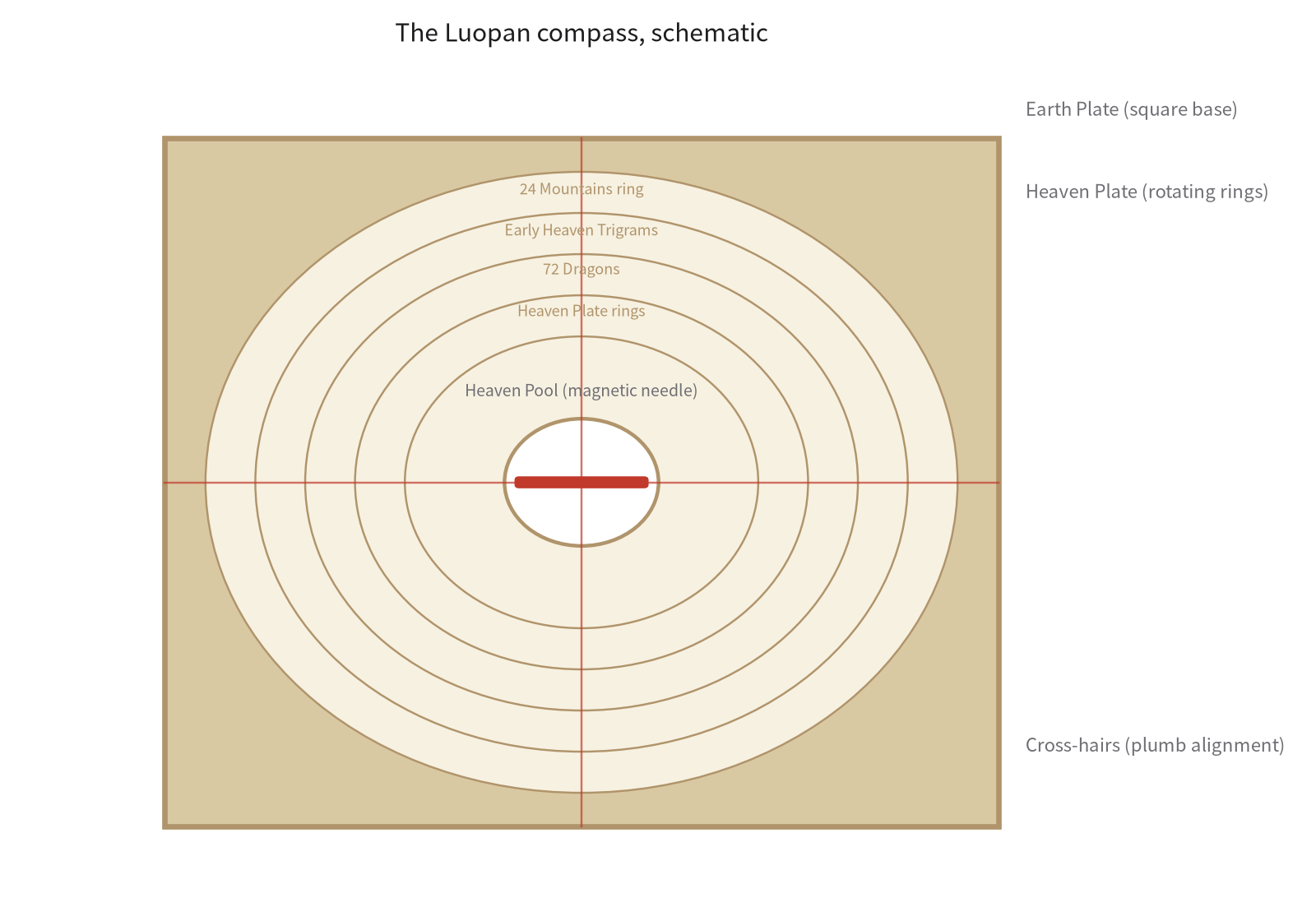
Anatomy of a Classical Luopan Compass:
- Earth Plate (Di Pan): The square outer wooden base that stabilizes the instrument against the body and aligns parallel with building walls using red nylon cross-hairs.
- Heaven Plate (Tian Pan): The central circular brass dial that rotates smoothly within the Earth Plate, containing concentric rings of mathematical and trigram data.
- Heaven Pool (Tian Chi): The central glass-covered compass housing containing a high-sensitivity magnetic needle floating over a red alignment line.
- The Concentric Rings: Displays Earth Branches (12 sector markers), Heavenly Stems (10 elemental markers), Eight Trigrams, Early and Later Heaven arrangements, and the 24 Mountains (24 sectors of 15 degrees each, making up 360 degrees).
On-Site Compass Measurement Protocol
Taking accurate readings requires a rigorous protocol to eliminate structural magnetic interference caused by modern steel rebar and electrical conduits:
- Ground-Level External Baseline Reading: The consultant steps at least ten paces away from the main building entrance, clear of parked automobiles, metal drain covers, and underground power lines. Holding the Luopan level at waist height, the consultant aligns the cross-hairs parallel to the main building entrance axis to capture the baseline facing degree.
- Building Entrance Foyer Reading: A second reading is taken three paces inside the main ground-floor entrance foyer to evaluate how internal structural steel affects the magnetic needle relative to the outside baseline.
- Unit Entrance Door Reading: Moving up to the client’s specific floor, the consultant takes a reading outside the unit entrance door, holding the Luopan parallel to the door frame.
- Primary Facade / Balcony Facade Reading: In modern high-rise apartments, the unit entrance door often opens into an enclosed, windowless interior hallway with minimal natural light and air flow. In such cases, the primary facade (Qi mouth) is defined by the main living room window or balcony wall that admits maximum light, air, movement, and panoramic views. The consultant takes multiple readings along this primary balcony glass wall.
Empty Lines and Death Lines (Kong Wang)
During compass measurements, the consultant checks whether the building facing degree falls on an Empty Line (Kong Wang). An Empty Line occurs when the compass reading lands exactly on the boundary dividing two sectors:
- Major Kong Wang (Great Empty Line): A compass reading landing directly on the boundary between two Eight Trigram sectors (e.g. exactly 22.5 degrees between North-East and East). This represents complete structural disharmony, causing severe financial disruption, chronic physical exhaustion, and erratic emotional behavior among occupants.
- Minor Kong Wang (Small Empty Line): A reading landing on the 1.5-degree line dividing two 15-degree Mountain sub-sectors within the same Trigram. Causes ongoing confusion, indecision, and inconsistent business outcomes.
When taking measurements for Mr and Mrs Teo, the ground baseline registered 138 degrees (South-East 2, Xun Mountain). The 12th-floor unit balcony window wall registered an identical 138 degrees, completely clear of any Kong Wang boundaries. This verified that the apartment possessed a stable, workable magnetic orientation Sitting North-West 2 (318 degrees) and Facing South-East 2 (138 degrees).
Phase 4: Detailed Interior Spatial Audit
With verified compass readings in hand, the consultant steps across the threshold into the interior of the home. Holding a clipboard with the floor plan overlay, the consultant conducts a systematic physical inspection across six critical internal zones. The goal is to evaluate how energy flows, concentrates, or stagnates through the layout.
1. The Main Door (Qi Kou – The Mouth of Qi)
The main door is the primary conduit through which environmental Qi enters the apartment. The consultant evaluates:
- Door Proportions: The main door must be proportional to the total floor area. An undersized door restricts incoming opportunity; an oversized door causes energy to scatter out rapidly.
- Swing Arc & Obstructions: The door must open smoothly to a full 90-degree angle without colliding with shoe cabinets, wall hooks, or clutter stored behind the door leaf.
- Direct Line of Sight (Door Rush): A main door that opens directly aligned with a back balcony window creates a straight-through energy channel (Chuan Tang Sha), causing money and opportunities to pass through the home without accumulating.
2. The Living Room and Central Palace (Zhong Gong)
The living room functions as the primary internal Bright Hall (Ming Tang), where incoming energy circulates before distributing into individual bedrooms. The consultant checks:
- Central Palace Clarity: The mathematical center of the floor plan (Central Palace) represents the heart of the home. Placing heavy physical obstructions, built-in storerooms, bathrooms, or kitchen stoves directly in the Central Palace creates stagnant energy that affects all occupants.
- Natural Lighting & Ventilation: Living spaces require ample natural daylight and steady air circulation to maintain healthy Yang energy levels.
3. The Kitchen and Stove Placement
In classical theory, the kitchen stove represents the Fire element and governs the family’s health, vitality, and wealth creation capacity. Key diagnostic checks include:
- Fire-Water Clash (Shui Huo Xiang Chong): Positioning the cooking stove directly opposite or immediately adjacent to (less than 12 inches from) the water sink or refrigerator creates a direct clash between Fire and Water elements, leading to digestive issues and frequent interpersonal friction.
- Heaven’s Gate Violation (Huo Shao Tian Men): The North-West sector of the floor plan corresponds to Qian Trigram (Heaven), representing the household head’s health and financial leadership. Placing the kitchen stove Fire element in the strict North-West sector creates “Fire Burning Heaven’s Gate,” an elemental conflict associated with severe headaches, respiratory issues, and business setbacks.
- Stove Wall Backing: The stove must rest against a solid, structural wall, never positioned on an open kitchen island or directly beneath an overhead window.
4. Master Bedroom and Bed Position
We spend one-third of our lives sleeping, making the master bedroom the most critical zone for health restoration and relationship stability. Diagnostic checks include:
- Command Position: The bed headboard must rest against a solid exterior or structural wall. The sleeper should be able to view the bedroom entry door from the bed without sitting directly inline with the doorway (Door Rush).
- Solid Wall Backing: Resting a headboard against a thin drywall partition separating the bedroom from an ensuite bathroom toilet pipe exposes the sleeper to damp, noisy water turbulence throughout the night.
- Overhead Structural Beams: Sleeping beneath heavy exposed concrete ceiling beams creates localized downward air pressure, causing localized physical soreness and restless sleep.
5. Home Office, Study, and Desk Placement
In the age of remote work, desk placement directly impacts executive decision-making, concentration, and income stability. Diagnostic checks include:
- Executive Backing: The desk chair must back onto a solid structural wall, giving the worker psychological security and strategic backing.
- Wen Chang (Academic / Intelligence Star) Activation: Positioning the study desk in the occupant’s personal Wen Chang sector enhances focus, exam performance, and professional writing output.
- Avoiding Mirror and Door Reflections: Placing large mirrors directly facing the desk creates visual distraction and cognitive fatigue over long work sessions.
6. Bathrooms, Restrooms, and Water Outlets
Bathrooms are moisture-heavy zones of energy consumption and drainage. Key diagnostic checks include:
- Avoiding Main Door Alignment: A bathroom door that opens directly facing the main entrance door pulls incoming energy straight down the drainage pipes.
- Avoiding Central Palace Placement: A bathroom situated in the center of the floor plan spreads dampness and foul air across surrounding living spaces.
- Door Moisture Control: Bathroom doors should remain closed when not in use, with exhaust fans maintained to prevent dampness from seeping into adjacent sleeping areas.
Phase 5: Time-Space Flying Star Mapping and Annual Influences
Once spatial observations and compass bearings are recorded, the consultant synthesizes physical layout data with temporal mathematics using Flying Star Feng Shui (Xuan Kong Fei Xing). This phase bridges physical architecture with time dynamics, explaining why a property that performed exceptionally well for twenty years might experience a sudden downturn, or why a quiet room becomes prone to health issues in a specific year.
The consultant begins by dividing the floor plan into a Nine-Palace (Jiu Gong) grid aligned with true magnetic directions. Next, they determine the building’s Period chart based on the San Yuan cycle:
- Period 7 Buildings: Completed between February 4, 1984 and February 3, 2004.
- Period 8 Buildings: Completed between February 4, 2004 and February 3, 2024.
- Period 9 Buildings: Completed between February 4, 2024 and February 3, 2044.
Using the building’s Period and its exact facing mountain degree (138 degrees SE2), the consultant constructs the baseline Flying Star Chart. Each sector of the Nine-Palace grid contains three core numbers:
- Base Star (Earth Base): Derived from the building’s construction Period. Represents foundational environmental energy.
- Mountain Star (Top Left): Derived from the base star at the sitting sector. Governs health, emotional well-being, personal relationships, and occupant support. Requires still, solid physical features (walls, headboards, elevated structures) to activate.
- Facing Star (Top Right): Derived from the base star at the facing sector. Governs wealth generation, cash flow, career opportunities, and financial expansion. Requires active, moving physical features (doorways, bright windows, open spaces, active water features) to activate.
Understanding Flying Stars in Period 9 (2024 – 2044)
On February 4, 2024, the global energy cycle transitioned from Period 8 (Earth) into Period 9 (Fire). This transition completely altered the prosperity status of all nine numbers:
- Star 9 (Purple Fire): The supreme prosperous governing star of Period 9. Brings rapid wealth expansion, fame, clarity, leadership, and emotional vitality.
- Star 1 (White Water): The upcoming growth star. Governs wisdom, career advancement, networking, and long-term business growth.
- Star 2 (Black Earth): Formerly a sickness star in Period 8, Star 2 becomes a usable secondary wealth star in Period 9, particularly for real estate, property development, and asset accumulation.
- Star 3 (Jade Wood) & Star 4 (Green Wood): Neutral or fading stars that require careful elemental management to avoid legal friction or mental overwork.
- Star 5 (Yellow Earth) & Star 7 (Red Metal): Highly negative, severe stars in Period 9. Star 5 brings sudden financial loss, illness, and obstacles. Star 7 brings verbal arguments, theft, and legal friction.
- Star 6 (White Metal) & Star 8 (White Earth): Fading past stars that represent stagnant, declining energy in Period 9 unless supported by favorable physical landforms.
Managing Annual Flying Star Influences (Sui Xing)
In addition to the baseline 20-year Period chart, dynamic annual stars shift positions every Chinese Solar Year (around February 4). The consultant overlays these annual stars onto the baseline chart to identify temporary yearly influences and prescribe preventive adjustments:
- Tai Sui (The Grand Duke): Occupies a 15-degree mountain sector matching the annual earthly branch (e.g. Dragon in 2024, Snake in 2025). The rule for Tai Sui is simple: sit facing Tai Sui, never confront Tai Sui directly by facing his sector during major meetings or renovations.
- Sui Po (Year Breaker): Occupies the sector directly opposite Tai Sui (180 degrees away). Avoid heavy structural drilling, wall demolitions, or loud construction in the Sui Po sector.
- San Sha (Three Killings): Spans a 90-degree cardinal direction annually. Avoid disturbing the San Sha sector with major structural work to prevent sudden minor injuries or project delays.
- Annual Five Yellow (#5 Wu Huang): The most severe annual affliction. When the annual #5 star lands in a key entryway or master bedroom, the consultant prescribes heavy Metal elemental cures (such as a clean, heavy brass object or copper wind chime) to drain the hostile Earth energy.
Phase 6: Complete Worked Teaching Example
To see how landform analysis, compass measurements, Flying Star calculations, and personal Ba Zhai factors synthesize during a residential consultation, let us walk through a complete teaching model. Note that this scenario is a constructed educational case study designed to demonstrate diagnostic protocols and actionable remedies within a modern apartment layout.
Property Profile and Occupant Background
The property under evaluation is a modern three-bedroom high-rise apartment unit with a total floor area of 1,200 square feet. The apartment complex was completed and ready for occupancy in mid-2025, placing it firmly within Period 9 (2024 to 2043). The unit is located on the 12th floor of an 18-story building situated in Bukit Timah.
The primary occupants are a married couple, Mr and Mrs Teo:
- Husband (Mr Teo): Born in 1982 (Ren Xu year). Personal Ming Gua is Xun Gua (Trigram 4, Wood), belonging to the East Group. Favorable sectors/directions: North (Sheng Qi), South (Tian Yi), East (Yan Nian), South-East (Fu Wei). Unfavorable sectors: North-East (Jue Ming), South-West (Wu Gui), West (Liu Sha), North-West (Huo Hai).
- Wife (Mrs Teo): Born in 1985 (Yi Chou year). Personal Ming Gua is Li Gua (Trigram 9, Fire), belonging to the East Group. Favorable sectors/directions: East (Sheng Qi), South-East (Tian Yi), North (Yan Nian), South (Fu Wei). Unfavorable sectors: North-West (Jue Ming), West (Wu Gui), South-West (Liu Sha), North-East (Huo Hai).
Because both occupants belong to the East Group, selecting favorable sleeping orientations and primary seating directions is simplified, as they share the same general set of auspicious directional cardinal points (North, South, East, South-East).
Step 1: On-Site External Landform Inspection
The consultation begins by surveying ground level and balcony views. The apartment block sits on elevated land with a taller 24-story residential tower positioned directly behind it to the Northwest, providing strong structural backing support (Black Tortoise). To the Northeast (left side looking out from balcony), a lower car park podium structure acts as a supportive Green Dragon. To the Southwest (right side), a neighboring apartment block of equal height acts as the White Tiger. In front of the living room balcony (facing Southeast), the view opens up into a large central courtyard featuring an outdoor swimming pool and landscaped gardens, serving as an excellent Bright Hall (Ming Tang).
However, one notable external Sha Qi issue is identified: from the master bedroom window facing East, the sharp roof corner of an adjacent multi-story car park points directly toward the window glass, forming a physical Zhan Dao Sha (Chopping Sabre Sha).
Step 2: Luopan Compass Reading and Facing Determination
Stepping down to the ground floor entrance clear of structural steel, the consultant records a baseline building facing degree of 138 degrees (South-East 2, Xun Mountain). Moving up to the 12th-floor unit, readings taken inside looking out through the living room balcony window measure exactly 138 degrees (South-East 2), matching the ground baseline. The unit door, which opens into an enclosed interior elevator corridor, faces 318 degrees (North-West 2, Qian Mountain).
Because the balcony wall provides the primary source of natural light, ventilation, panoramic views, and atmospheric activity overlooking the pool courtyard, the consultant establishes the property orientation as Sitting North-West 2 (Qian Mountain, 318 degrees) and Facing South-East 2 (Xun Mountain, 138 degrees) in Period 9.
Step 3: Generating the Period 9 Flying Star Chart
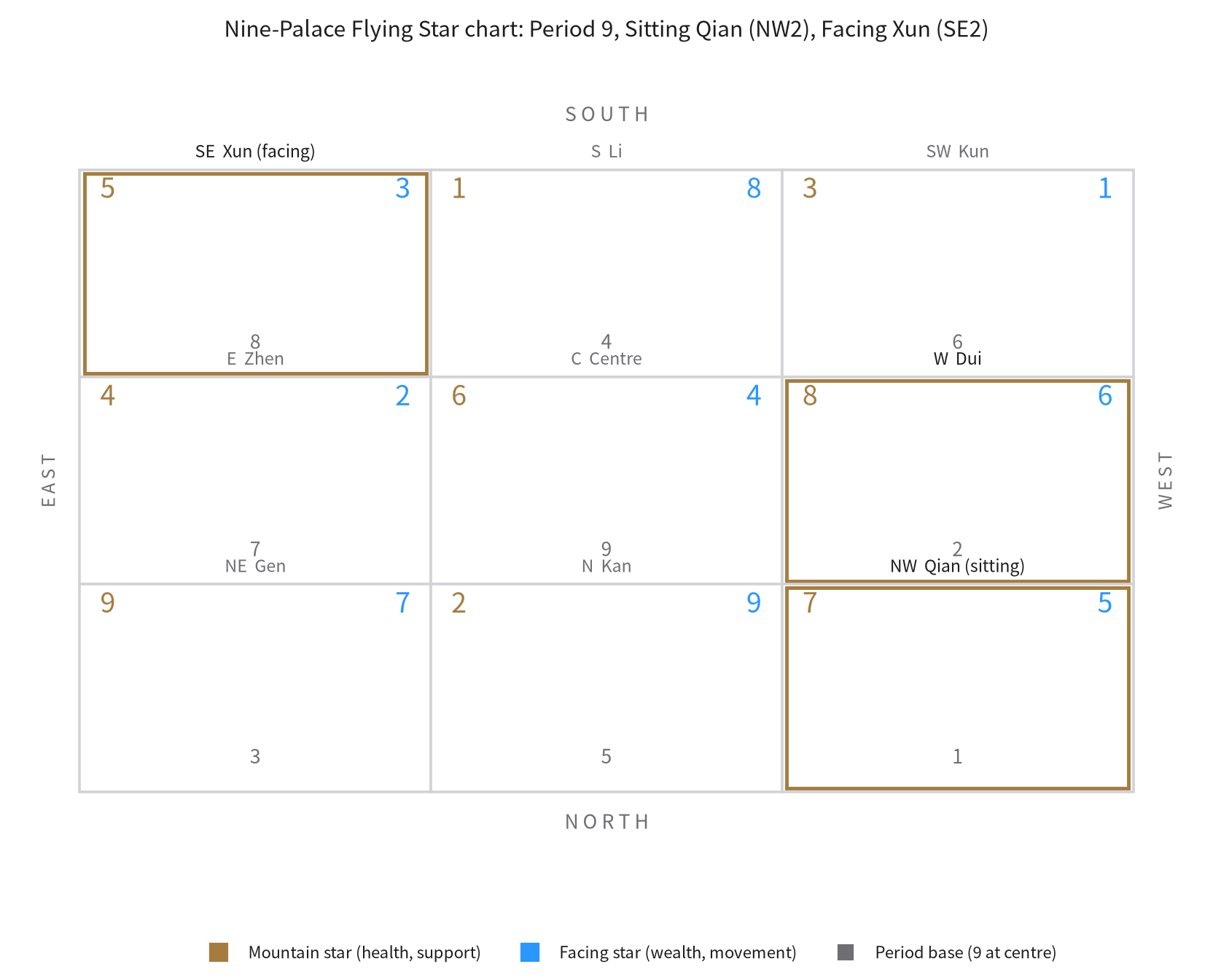
For a Period 9 house Sitting North-West 2 (Qian) and Facing South-East 2 (Xun), the consultant calculates the Nine-Palace Flying Star distribution:
- Facing Sector (South-East): Contains Base Star 8, Mountain Star 5, Facing Star 3. The postcard view comes with a catch: the 5-3 combination beneath the balcony is quarrelsome and restless, so the consultant treats the balcony as bright pass-through space rather than the home’s wealth engine.
- Sitting Sector (North-West): Contains Base Star 1, Mountain Star 7, Facing Star 5. In Period 9, Star 7 is a stagnant, declining star associated with verbal friction and financial drain, compounded by the obstacle energy of Star 5 at the sitting sector.
- West Sector (Location of Main Entrance Door): Contains Base Star 2, Mountain Star 8, Facing Star 6. The main door sits in the West sector where the door’s facing Star 6 (Metal) drains the mountain Star 8 (Earth), creating potential career friction and nervous tension.
- South Sector (Location of Master Bedroom): Contains Base Star 4, Mountain Star 1, Facing Star 8. Star 1 (Water) as the Mountain Star provides excellent support for health, intellect, and personal relationships.
- North Sector: Contains Base Star 5, Mountain Star 2, Facing Star 9. The reigning Period 9 prosperity star, Facing Star 9, lands here: the unit’s true wealth engine sits on the quiet North side of the living room, not at the balcony.
- North-East Sector: Contains Base Star 3, Mountain Star 9, Facing Star 7. The mountain version of Star 9 supports health, steadiness and leadership for the occupants.
- North-West / West Kitchen Placement: The kitchen stove is located on a counter stretching into the North-West sector of the layout.
Step 4: Audit Findings and Identified Flaws
Synthesizing physical layout observations, personal Gua numbers, and Flying Star positions reveals four primary diagnostic issues:
- Fire Burning Heaven’s Gate (Huo Shao Tian Men): The kitchen stove is situated in the North-West sector of the home. In Eight Trigrams, North-West is Qian (Heaven), representing the husband’s health and financial leadership. Placing the stove Fire element in the North-West creates severe elemental tension. In addition, inside the kitchen, the stove sits directly adjacent to the sink with less than 12 inches of separation, causing a direct Fire-Water clash.
- Main Door Metal-Over-Earth Drain: The unit entrance door in the West sector features Mountain Star 8 (Earth) with Facing Star 6 (Metal). The physical door is painted a bright metallic white, amplifying the cold Metal energy of Star 6, which drains the Earth beneath it, leading to minor daily misunderstandings between the couple when entering or leaving.
- Master Bedroom Headboard Alignment and External Sha Qi: The master bed headboard is currently placed against a light drywall partition that separates the bedroom from the ensuite bathroom. Whenever the bathroom door opens, damp air drifts over the pillows. In addition, the bed is aligned directly inline with the eastern window where the external car park roof line (Zhan Dao Sha) points at the room.
- Under-Utilized Prosperous North Sector: The North palace carries Facing Star 9, the reigning Period 9 wealth star, but the occupants currently use that corner of the living room as a dumping ground for the children’s scooters, delivery boxes and a dying plant, blocking light and stifling active Qi movement. The South-East balcony, postcard view notwithstanding, sits on the 5-3 combination: fine as an airy walkway, the wrong place to chase prosperity.
Step 5: Actionable Solutions and Remedies
The consultant provides a clear, practical action plan grounded in environmental design:
- Kitchen Restructuring: Because breaking down walls to move the kitchen is cost-prohibitive, the consultant prescribes a targeted spatial shift. The stove is relocated along the counter four feet to the East, moving it out of the strict North-West 15-degree mountain boundary and into the West sector. To resolve the Fire-Water clash with the sink, a thick solid teak butcher block divider is permanently installed between the stove and sink, introducing the Wood element to mediate between Water and Fire (Water feeds Wood, Wood feeds Fire).
- Main Entrance Harmonization: To steady the Star 8/6 Metal-over-Earth drain at the front entrance, the consultant recommends repainting the interior side of the main entrance door in a soft warm cream (Earth tone). Earth re-grounds the drained Mountain Star 8 while softening the cold authority of Star 6, transforming friction into settled energy. A warm, well-lit entrance light is installed to elevate Qi.
- Master Bedroom Realignment: The master bed is rotated ninety degrees so the headboard rests securely against a solid exterior load-bearing wall on the South side of the room. This aligns the occupants’ heads toward the South (a highly auspicious Tian Yi direction for the husband and Fu Wei for the wife). To neutralize the external Zhan Dao Sha from the car park roof, a subtle sheer window blind coupled with a low green indoor potted plant is placed on the East window sill, filtering incoming light and visually blocking the sharp angle.
- Activating the Period 9 North Wealth Sector: The consultant instructs the couple to completely clear the clutter from the North corner of the living room and relocate the shoe cabinet blocking the North window, keeping that wall bright, open and lightly used every day. A clean, slow-moving water fountain or well-maintained low aquarium is positioned near the North window to gently activate Facing Star 9, drawing prosperous energy into the home. The South-East balcony keeps its light sheer curtains and stays an airy walkway, enjoying the view without being asked to be a wealth corner.
Step 6: Implementation Schedule and Post-Audit Follow-Up
The consultant selects an auspicious date and time (Ze Ri) based on the husband and wife’s BaZi charts to execute the physical changes (moving the bed, installing the wooden butcher block divider, repainting the door, and starting the balcony water feature). Six months after implementing these changes, a follow-up review confirms that Mr Teo’s sleep quality restored completely, domestic disagreements diminished, and Mrs Teo secured a major career promotion, demonstrating how practical spatial realignment yields tangible life improvements.
Phase 7: Deliverables, Actionable Remedies, and Implementation Timing
When an on-site consultation concludes, what tangible assets should you actually hold in your hands? A professional practitioner does not offer vague verbal hand-waving and leave. Within five to seven business days, you should receive a formal written Audit Report that functions as a permanent reference document for your property.
Standard Professional Consultation Deliverables:
- Scaled Floor Plan Overlay: A high-resolution blueprint showing the exact 24-Mountain compass wheel and Nine-Palace Flying Star grid overlaid across your floor plan, identifying exact boundaries for every sector.
- Occupant BaZi & Gua Profile Summary: Detailed personal directional charts for all primary occupants, indicating individual favorable sleeping, desk, and seating orientations.
- Zone-by-Zone Diagnostic Breakdown: Written evaluations for every room, flagging landform strengths, spatial defects, elemental clashes, and specific corrective actions.
- Actionable Remedy Matrix: A prioritized checklist of physical, non-superstitious remedies utilizing natural elemental mediums (colors, lighting, structural repositioning, water features, plants, and metal balances).
- Auspicious Date Selection Schedule (Ze Ri): Specific dates and time windows tailored to the occupants’ BaZi charts for executing major physical changes, such as moving beds, starting renovations, repainting doors, or positioning water features.
Understanding Classical Elemental Remedies
A legitimate practitioner resolves energy imbalances using the Five Elements (Wu Xing): Wood, Fire, Earth, Metal, and Water. Remedies rely on physical mediums, structural shifts, and lighting rather than commercial figurines or religious items:
- Wood Mediums: Healthy broad-leaf green plants, solid wooden furniture, teak dividers, green and teal color accents. Used to mediate Fire-Water clashes or nourish Fire stars.
- Fire Mediums: Warm ambient lighting, accent lamps, red or purple cushions, active electronic equipment. Used to activate Earth stars or support Period 9 Fire energy.
- Earth Mediums: Natural ceramic pots, heavy stone sculptures, quartz crystals, beige and terracotta color schemes. Used to anchor unstable space or support Metal stars.
- Metal Mediums: Heavy solid brass objects, copper bowls, iron bed frames, white or metallic grey paint finishes. Used to drain hostile #5 Earth or #2 Sickness stars.
- Water Mediums: Clean, slow-moving water fountains, low aquariums, navy blue or charcoal paint finishes. Used to stimulate Facing Stars (#9, #1) or soften harsh Metal-Wood clashes.
Phase 8: Fee Structures, Pricing Standards, and Regional Market Comparisons
How much should a genuine residential feng shui audit cost, and how can you tell if a consultant is overcharging? Pricing across global markets varies significantly based on property size, practitioner reputation, market maturity, and the scope of analytical work required.
Common Professional Fee Models:
- Per Square Foot / Square Meter Rate: Most common for landed homes and luxury estates. Rates typically range from $1.50 to $4.00 USD per square foot ($15 to $40 USD per square meter).
- Flat Fee by Property Category: Standard model for residential urban apartments (e.g., fixed tiers for 2-bedroom flats, 3-bedroom units, penthouse apartments, or detached houses).
- Retainer / Package Pricing: Used when combining property selection pre-audit, full residential audit, and annual updates into an ongoing advisory package.
Regional Market Pricing Comparison Table
The table below outlines established market fee ranges and standard scope expectations across major international metropolitan centers:
| Region / Market | Property Type / Category | Typical Fee Range | Standard Scope of Work Included | Pricing Red Flags to Avoid |
|---|---|---|---|---|
| Singapore |
HDB Flat (3 to 5 Room) Condominium Unit (1,000 – 1,800 sq ft) Landed Property / Terrace House |
$800 – $1,500 SGD $1,500 – $3,200 SGD $3,500 – $8,000+ SGD |
On-site compass measurement, floor plan Flying Star mapping, occupant BaZi analysis, full written report, date selection for remedies, 3 to 6-month follow-up. | Consultants charging under $300 SGD who rely entirely on selling $3,000 SGD commercial crystals or jade items during the audit. |
| Hong Kong |
Standard High-Rise Flat (500 – 1,000 sq ft) Luxury Flat / Mid-Levels (1,500+ sq ft) Detached House / Peak Villa |
$6,000 – $15,000 HKD $18,000 – $40,000 HKD $50,000 – $120,000+ HKD |
Detailed Luopan landform assessment, time-space Flying Star calculation, date selection, direct BaZi alignment for all family members. | Unusually cheap flat fees ($2,000 HKD) that double automatically if you ask for date selection or written reports as hidden add-ons. |
| London / UK |
Urban Apartment / Flat (1 to 3 Bed) Townhouse / Semi-Detached House Country Estate / Large Detached |
£600 – £1,400 GBP £1,200 – £2,800 GBP £3,000 – £7,500+ GBP |
Pre-audit desk research, on-site environmental assessment, 24-Mountain compass work, full written report with floor plan overlays. | Practitioners charging full rates who perform audits entirely via phone video calls without taking physical ground compass readings. |
| New York / US |
Urban Condo / Apartment (1 to 2 Bed) Suburban Single-Family House Luxury Residence / Multi-Story |
$1,000 – $2,500 USD $2,200 – $4,800 USD $5,000 – $12,000+ USD |
On-site physical audit, Flying Star & Ba Zhai mapping, occupant birth chart review, practical spatial solutions, written report. | Consultants who charge high initial fees and then insist you must re-audit the property every single month at full price. |
| Australia / Sydney |
Suburban Apartment / Unit Single-Family Detached Home Acreage / Luxury Property |
$1,100 – $2,200 AUD $2,200 – $4,500 AUD $5,000 – $10,000+ AUD |
Complete on-site assessment, landform check, Luopan measurements, custom Flying Star overlays, BaZi alignment, written audit report. | Quotes that omit written deliverables, offering only brief verbal notes unless you pay steep additional documentation fees. |
Evaluating the Advice: Red Flags, Bad Actors, and Commercial Upselling
Let me introduce you to Master Roland. He arrives at your doorstep dressed in an opulent silk jacket, carrying an impressive gold-lacquered compass. Within two minutes of stepping into your living room, his face darkens. He gasps, points at your main entrance, and informs you that your apartment carries a devastating curse that will cause bankruptcy and health ruin within six months. But do not panic: he just happens to have a pair of special $4,000 heavy bronze Pi Xiu statues in the trunk of his car that will neutralize the threat if placed immediately near your doorway.
Master Roland is not a classical feng shui practitioner. He is a high-pressure salesman operating a fear-based commercial upselling scheme. Every industry has its charlatans, but feng shui attracts an unusual number because clients often seek advice during moments of life vulnerability, such as career turbulence, divorce, or illness.
To protect yourself and your wallet, learn to recognize the four major red flags of predatory feng shui practice:
1. Fear-Mongering and Emotional Manipulation
Ethical practitioners communicate in calm, analytical diagnostic terms. They explain spatial flaws as manageable environmental friction and offer straightforward design adjustments. Predatory bad actors rely on extreme scare tactics, telling clients that their home contains deadly curses, disaster energy, or spiritual curses that require immediate costly intervention.
2. Mandatory Purchase of Expensive Commercial Trinkets
Classical feng shui operates on physical environmental mechanics: materials, colors, lighting, spatial flow, water movement, and geometric alignment. It never requires buying specific branded commercial trinkets, jade lions, gold coins, brass statues, or special charm bracelets. When a consultant insists that only their proprietary $3,000 items can fix your home, walk away immediately.
3. Vague, Untestable, and Mystical Claims
A legitimate audit is transparent and logical. The consultant shows you the compass degree, explains the Flying Star numbers, references classical texts, and demonstrates why a specific furniture move makes sense. Commercial bad actors rely on vague, untestable statements like “I feel a dark spiritual presence in this corner” or “My third eye tells me this room loses money,” avoiding clear mathematical explanations.
4. Demanding Drastic, Unrealistic Structural Demolition
A skilled classical consultant respects building engineering and financial reality. Except in extreme structural cases, remedies involve targeted adjustments: moving beds, shifting stove placements, repainting doors, adding lighting, or positioning water features. Beware of practitioners who insist you must tear down structural load-bearing walls or relocate main apartment doors as their only initial recommendation.
Red Flags vs Professional Practice Comparison Table
Use the diagnostic table below to evaluate any consultant you consider hiring:
| Diagnostic Aspect | Red Flag / Aggressive Upsell Behavior | Professional / Ethical Consultant Practice | How Client Should Respond |
|---|---|---|---|
| Initial Diagnostic Communication | Uses fear-inducing language, predicts extreme disasters, death, or severe illness to induce panic. | Explains spatial flaws objectively as manageable environmental friction; focuses on practical solutions. | Reject sensational claims; ask for the mathematical and landform reasoning behind any diagnostic claim. |
| Remedies & Corrective Items | Insists client must purchase expensive proprietary trinkets, statues, brass items, or crystals directly from them. | Prescribes remedies using standard home materials, paint colors, lighting, plants, regular furniture, or plain water features. | Refuse to purchase proprietary merchandise; insist on simple elemental Cures using standard home decor items. |
| Compass & Analytical Methodology | Takes quick smartphone compass readings or guesses directions without explaining the methodology. | Uses a professional mechanical Luopan; takes ground baseline and balcony readings; explains 24-Mountain bearings clearly. | Ensure the consultant takes physical readings away from metal interference and explains the property facing degree. |
| Structural Recommendations | Demands major, expensive demolition work (tearing down walls, moving main doors) as the only solution. | Offers non-invasive, realistic spatial adjustments (rotating beds, shifting desk angles, adding plants, repainting). | Request cost-effective, non-structural alternatives before committing to any major renovation work. |
Comparing the Major Schools in Practice: Synthesizing the Audit
What happens during an audit when two classical schools offer conflicting advice? For example, suppose Eight Mansions indicates that your main entrance sits in your worst personal sector (Jue Ming), but Flying Star reveals that exact same sector holds the reigning Period 9 wealth star, Facing Star 9. How does a professional consultant resolve the contradiction?
In classical practice, multi-school conflicts are resolved using a clear diagnostic hierarchy built on environmental priority:
- Tier 1 Priority (Form School / Landforms): Physical terrain, surrounding high-rise towers, roads, drainage canals, and sharp external Sha Qi angles always override interior compass theories. If an external landform is severely defective, internal star adjustments cannot compensate.
- Tier 2 Priority (Flying Star / Xuan Kong): Time-space dynamic energy distribution across 20-year periods and annual star shifts takes secondary priority. Facing and Mountain stars dictate wealth accumulation and health capacity for the entire structure.
- Tier 3 Priority (Eight Mansions / Ba Zhai): Personal Ming Gua alignment governs fine-tuning individual room assignments, headboard orientations, and desk directions within the established Flying Star framework.
Decision Framework Matrix for Resolving Multi-School Conflicts
The matrix below demonstrates how an experienced practitioner synthesizes conflicting data across schools into a coherent audit plan:
| Scenario / Conflict | Form School Perspective | Flying Star Perspective | Eight Mansions Perspective | Synthesized Professional Resolution |
|---|---|---|---|---|
| Main Entrance in Bad Eight Mansions Sector but Good Flying Star Sector | Verifies front entrance receives clean, uncluttered open space (Bright Hall) clear of external road rush. | Sector contains prosperous Facing Star 9 in Period 9, creating excellent wealth potential. | Sector is Jue Ming (Total Loss) for the household head’s personal Gua. | Maintain main entrance in this sector to capture Flying Star wealth energy. Apply Water element decor to soften Jue Ming friction and align headboard/desk in favorable Gua sectors inside. |
| Master Bedroom in Auspicious Gua Sector but Afflicted by External Sha Qi | Identifies sharp car park roof line (Zhan Dao Sha) pointing directly at bedroom window glass. | Sector contains favorable Mountain Star 1 supporting health and personal relationships. | Sector is Tian Yi (Heavenly Doctor) for primary occupant, ideal for sleep. | Do not relocate bedroom. Keep bed in room but position headboard against solid wall out of direct line with window. Install sheer window blinds and green potted plant on sill to diffuse Zhan Dao Sha. |
| Kitchen Stove in Favorable Gua Direction but Violates Heaven’s Gate (North-West) | Checks that stove rests against solid structural backing wall away from window drafts. | Sector contains neutral baseline stars that do not directly conflict with Fire. | Stove location represents Sheng Qi (Life Generating) directional sector for wife. | Relocate stove out of North-West mountain boundary into West sector to resolve “Fire Burning Heaven’s Gate.” Maintain favorable seating directions in dining area to preserve Gua benefits. |
Frequently Asked Questions (FAQ) About Residential Feng Shui Audits
Below are ten direct answers to the questions clients ask most frequently when considering a professional residential consultation:
1. How long does an on-site residential Feng Shui consultation typically take?
A thorough on-site audit for a standard urban apartment (800 to 1,800 square feet) takes between two and three hours. Larger landed estates, multi-story townhouses, or complex penthouses require four to six hours. If a consultant spends less than forty-five minutes on-site, they are skipping essential external landform checks and compass verification protocols.
2. Do I need to break down walls or do major structural renovations to fix bad Feng Shui?
In over ninety percent of residential audits, major structural demolition is completely unnecessary. Classical remedies rely on practical spatial adjustments: rotating beds against solid walls, shifting desk angles, repainting doors, adjusting room lighting, clearing clutter, and positioning natural elemental mediums (water features, plants, metal balances). Structural alterations are reserved only for extreme physical defects.
3. Can I conduct a Feng Shui audit before purchasing or renting a property?
Yes. A pre-purchase or pre-lease evaluation is the smartest way to use feng shui advice. Evaluating multiple candidate floor plans and building locations allows you to select a unit with strong natural landforms, favorable facing orientations, and clean Flying Star charts before signing a binding contract, saving thousands in potential modification costs later.
4. What is the difference between personal BaZi (Four Pillars of Destiny) and residential Feng Shui?
Personal BaZi is an astrological diagnostic system based on your exact birth year, month, day, and hour. It maps your internal personal capacity, personal talents, health tendencies, and timing luck cycles over life. Residential Feng Shui is an environmental physics system that evaluates the physical space you inhabit. BaZi tells us who you are; Feng Shui optimizes the environment that supports you.
5. How often should a home Feng Shui audit be updated?
A thorough baseline audit based on Form School and 20-year Flying Star periods remains valid for as long as you reside in the property without executing major structural additions. However, brief annual reviews (often conducted via floor plan updates) are recommended every January or February to manage shifting annual Flying Stars, Tai Sui, and Five Yellow afflictions.
6. What happens if husband and wife belong to opposite groups (East Group vs West Group)?
This is extremely common and presents no major obstacle. A professional practitioner synthesizes the home by prioritizing the main entrance and primary living spaces for the primary breadwinner, while aligning the master bed headboard to support the spouse who requires greater sleep restoration. Room assignments and desk orientations are then fine-tuned individually.
7. Do Feng Shui remedies require religious rituals, spiritual chanting, or specific beliefs?
No. Classical feng shui is an environmental diagnostic discipline grounded in geography, geometry, lighting, air circulation, and elemental physics. It requires zero religious beliefs, spiritual chanting, or superstitious faith. Practical remedies function through physical environmental mechanics regardless of an occupant’s personal belief system.
8. How do multi-story houses or duplexes differ from single-level apartments during an audit?
Multi-story properties require taking individual compass measurements on every level to verify vertical magnetic consistency. The ground floor main entrance establishes the primary facing chart, while upper floors are evaluated for vertical stair rush, bathrooms positioned above main entryways, and headboards resting directly beneath upper-floor plumbing fixtures.
9. What if my main entrance faces an unfavorable Eight Mansions direction that I cannot physically change?
You do not need to rebuild your entrance door. An unfavorable entrance direction under Eight Mansions is easily counterbalanced by ensuring your sleeping position, home office desk, and primary seating face your auspicious personal Gua directions, and by maintaining a strong Flying Star wealth configuration in the entryway.
10. Are online or remote Feng Shui consultations as accurate as in-person audits?
Remote audits can analyze floor plans, BaZi charts, and satellite landforms accurately, but they cannot replace on-site compass verification. Local structural steel, electrical panels, and subtle micro-landforms can alter magnetic readings by several degrees. For maximum accuracy, an in-person audit with direct Luopan measurements is always preferred.
Conclusion: Navigating Your Feng Shui Journey with Clarity
An authentic classical feng shui consultation is an empowering, rational process of environmental optimization. It is not about surrendering your independent critical thinking to fear tactics, nor is it about cluttering your living room with expensive commercial trinkets. It is about understanding how physical terrain, architecture, magnetic alignment, and time cycles influence your daily life.
By observing tangible landforms, taking precise mechanical Luopan measurements, calculating Flying Star charts, and applying simple elemental remedies, a qualified practitioner helps you shape an environment that supports your health, relationships, and financial career goals. Step into your consultation with clear expectations, ask rigorous questions, insist on logical explanations, and use feng shui as what it was always meant to be: a practical, time-tested tool for living in harmony with the natural forces that surround us.
Where to go next
Most audit timing decisions lean on the calendar: the classical date selection field manual explains the logic. The people living in the house have charts of their own, covered from the ground up in The Day Master Files. For a second opinion before you hire anyone, our guide on how to find a good Feng Shui master lists the questions worth asking. And if a yes or no is all you need tonight, the I Ching casting manual is the older instrument.
Leave a Reply
You must be logged in to post a comment.