The one character that is actually you
A woman I will call Mei Ling had her chart read three times by three different people before she gave up and said the thing that brought me into this conversation: everyone told her about her wealth corners and her marriage years, and not one of them pointed at the single character that is actually her. She knew her lucky colours. She did not know herself.
Every BaZi chart has eight characters. Four pillars, two characters each, drawn from the year, month, day and hour you were born. Seven of them describe your circumstances: your parents, your era, your career field, your children, the people who help you, the people who drain you.
The eighth is you. It is called the Day Master, and almost every reading you have ever had was secretly about it, whether or not anyone said so.
That character is called the Day Master, or 日元 in Chinese. It is the Heavenly Stem sitting on top of your Day Pillar. If you learn only one thing from this entire article, let it be this: in the Zi Ping method of chart reading, the craft most people mean when they say BaZi, the whole chart is read from the position of that single stem. Everything else in the chart is assessed by how it relates to the Day Master. Fire in your chart is either your expression, your fame, your temper, or your money, depending on where the Day Master stands. Take the same fire and place it in a different chart, and it means something else entirely.
It is a strange idea at first. Western astrology puts you in one of twelve sun signs and hands you a personality description. BaZi goes deeper and does something more interesting: it refuses to describe you in isolation. You are one character in a system of relationships. You cannot be understood alone, only in context. A strong tree in a desert is struggling. The same tree by a river is an oak that will outlive everyone who mocked it in primary school.
I have watched students spend years memorising stars and gods and combinations while skipping the foundational question: what is the Day Master made of, and what does it need? It is like collecting recipes before learning how to taste. This article is the tasting lesson. We will build a chart from scratch, meet all ten Day Masters one by one, learn how strength and weakness actually work, walk through a complete reading, and finish with the classical sources so you can go further on your own.
One promise before we start. I will not sell you destiny here. BaZi is not fate written in stone, and any reader who tells you it is, is selling something. It is a language of patterns and tendencies, four thousand years in the making, and it sits beautifully beside its sister art of decision timing, our beginner guide to reading a Qi Men Dun Jia chart, and like any language it rewards people who study it properly and embarrasses people who skim it. Fair warning: this is a long article, roughly a short book chapter. Make a cup of tea. It is worth it.
How a chart is built: eight characters from four moments
Before you can find your Day Master, you need to understand where it comes from. A BaZi chart is not made from your birth date in the Western sense. It is made from the positions of the ancient Chinese sexagenary calendar, called the Sixty Jiazi, at four moments of your birth: the year, the month, the day and the two-hour block.
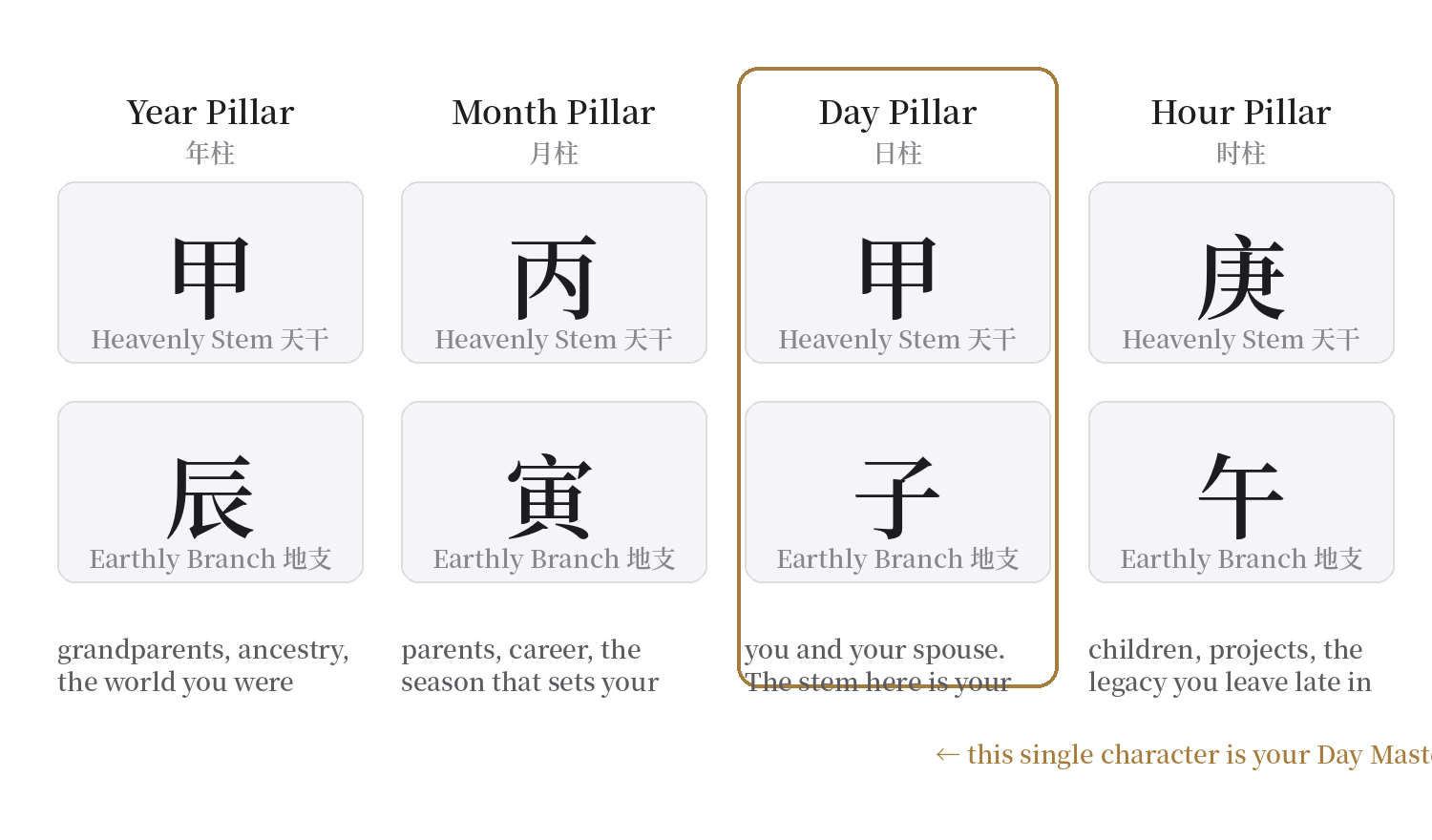
Each pillar has two parts. On top sits a Heavenly Stem, 天干: one of ten characters, which cycle through five elements in their yang and yin forms. The stems are pure, visible, external, like the weather. Underneath each stem sits an Earthly Branch, 地支: one of twelve characters, which correspond to the twelve zodiac animals and the twelve two-hour periods of the day. The branches are dense, hidden, internal, like the soil. Together they form a pillar, and four pillars form the chart.
Here is the crucial detail most beginners miss: the branches are not single elements. Each branch hides up to three stems inside it, like rooms inside a house. The Rabbit looks like pure yin wood, but the Dragon, which people casually call an earth sign, actually hides yin earth, yin wood and yin water within it. This is why two people born in the same year can live completely different lives. The visible animal is the least of it.
| Earthly Branch | Zodiac animal | Hidden stems (in order of importance) | Main element |
|---|---|---|---|
| Zi 子 | Rat | Gui 癸 | Yin Water |
| Chou 丑 | Ox | Ji 己, Gui 癸, Xin 辛 | Yin Earth |
| Yin 寅 | Tiger | Jia 甲, Bing 丙, Wu 戊 | Yang Wood |
| Mao 卯 | Rabbit | Yi 乙 | Yin Wood |
| Chen 辰 | Dragon | Wu 戊, Yi 乙, Gui 癸 | Yang Earth |
| Si 巳 | Snake | Bing 丙, Geng 庚, Wu 戊 | Yang Fire |
| Wu 午 | Horse | Ding 丁, Ji 己 | Yin Fire |
| Wei 未 | Goat | Ji 己, Ding 丁, Yi 乙 | Yin Earth |
| Shen 申 | Monkey | Geng 庚, Ren 壬, Wu 戊 | Yang Metal |
| You 酉 | Rooster | Xin 辛 | Yin Metal |
| Xu 戌 | Dog | Wu 戊, Xin 辛, Ding 丁 | Yang Earth |
| Hai 亥 | Pig | Ren 壬, Jia 甲 | Yang Water |
A word on time, because this is where charts go wrong. BaZi uses solar time, not clock time. The year does not change on January first. It changes at Li Chun, the Beginning of Spring, usually February fourth or fifth. If you were born in late January, you belong to the previous year. The months change at the solar terms, roughly every thirty days. And the day, in the classical system, begins at 11pm, not midnight: the Rat hour runs from 11pm to 1am and straddles both days. A person born at 11:40pm has the next day’s pillars. This single detail has broken more readings than any other, and it is why an honest practitioner asks for birth location. Singapore sits at longitude 104 degrees east, which means solar time runs about half an hour behind the clock, and that half hour can move your hour pillar to a different character.
Now you know what the eight characters are. Time to meet yours.
Meeting the ten Day Masters
There are only ten Day Masters, because there are only ten stems. Five elements, each in a yang and a yin flavour. Below is an honest sketch of each one. Treat these as first impressions, not verdicts. The full picture depends on strength, season and combinations, which we cover in the next section. But the stem colours everything. It is the raw material, and you can learn to spot the stems in people you know.
Jia 甲, the big tree
Jia is yang wood: the tall tree, the pillar, the one who grows upward and refuses to bend. People with a Jia Day Master tend to have principles they will not trade for convenience. They are direct, sometimes blunt, and they take on responsibility the way a trunk takes on branches. Give a Jia person a cause and they will carry it for decades. The shadow side: stubbornness that looks like strength but is really fear of being wrong. A Jia who will not prune becomes rigid, and everyone around them quietly learns to stop suggesting anything. They respect people who stand up to them and secretly resent those who cave. Career-wise you find them in leadership, engineering, education, activism, anywhere growth is measurable. When unbalanced, the classic patterns are tension in the neck and shoulders, gallbladder and liver complaints in the classical correspondence, and a private exhaustion from carrying everyone.
Yi 乙, the vine
Yi is yin wood: grass, flowers, the vine that climbs. Where Jia confronts, Yi adapts. Yi Day Masters are flexible, socially graceful and genuinely good at making things beautiful. They survive conditions that snap stronger plants, because they bend. Do not mistake the softness for weakness. A vine can strangle a tree; it just takes longer and nobody sees it happening. Their weakness is exactly the mirror of the strength: so much adaptation that the self gets lost in the arrangements made for other people, and a tendency toward indirectness, hinting instead of asking. Yi people thrive with structure around them, a trellis to climb, a strong team, a good system. Alone and unsupported, they scatter. You meet them in design, teaching, medicine, counselling, hospitality, anything that rewards sensitivity and tact.
Bing 丙, the sun
Bing is yang fire: the sun itself. Bing Day Masters are warm, visible, generous, and they light up rooms without trying. They speak openly, dislike grudges, and forgive faster than most people find comfortable. Their attention is like sunlight: delightful when it lands on you, and it lands on everyone in rotation, which is why some partners of Bing people feel loved but not especially chosen. The shadow: a need to shine that quietly organises their whole life, occasional vanity, and a temper that flares and is gone, leaving others to deal with the burnt field. In the classical texts the sun is the most public of the ten stems, and many performers, speakers, salespeople and founders are Bing. When a Bing person learns that they can be warm without being the centre, they become the most generous people in the room, and the people around them grow like everything under good weather.
Ding 丁, the candle
Ding is yin fire: the candle, the lamp, the hearth. Where the sun illuminates a field, the candle illuminates one face at a time. Ding Day Masters are focused, insightful and often quietly brilliant at one or two things they have loved since childhood. They care about meaning, not attention, and they make the people they love feel seen in a way a Bing never can. The trade is fragility of intensity. A candle burns with all it has and can gutter in wind, which in real life looks like burnout, overthinking, and moods that depend heavily on their immediate environment. Ding people are often writers, researchers, therapists, craftspeople. They suffer in loud, chaotic workplaces, and they bloom with one or two people who steady the flame. In classical reading, Ding is also the most interested in the metaphysical, the traditional, the symbolic, because candles shine brightest at night.
Wu 戊, the mountain
Wu is yang earth: the mountain, the great wall. Wu Day Masters are stable, patient, slow to commit and nearly impossible to move once they have. They are the people others lean on, sometimes until the Wu person quietly disappears under everyone’s expectations. Their word is their bond; they keep promises they made a decade ago, and they remember. The shadow is heaviness. Wu can be immovable on things that deserved a second look, and emotionally dense, genuinely confused by other people’s need for verbal affection, which they prefer to express through acts, food, and being there. They suit management, real estate, banking, logistics, governance. When imbalanced, the classical readings point to the stomach and digestion, and the pattern is apt: Wu people swallow everything and have trouble processing it. The best Wu people are the calm in a storm. The worst are the wall you cannot talk to.
Find your own Day Master in five minutes
Before the ten portraits, do this once. You will get more out of every section afterward if you have your own character in hand while reading.
Step one, write down your birth date, time and city. The city matters more than most people expect, because the calculator needs your longitude to convert clock time into solar time. A person born at 9:40pm in London and a person born at 9:40pm in Kuala Lumpur are not living through the same solar hour even if a website’s dropdown treats them as equivalent.
Step two, feed those details into a BaZi chart calculator that asks for the city, not just the country, and that mentions solar terms or true solar time somewhere in its documentation. There are decent free ones; there are also sloppy ones that use the calendar year instead of the Li Chun boundary, and they quietly assign January babies to the wrong year animal. If your report shows the Beginning of Spring mentioned anywhere near your February birth, you have found a careful one.
Step three, sanity-check the output against the rule of the hour. The Rat hour runs 11pm to 1am, the Ox 1am to 3am, and so on in two-hour blocks through the Rooster at 5pm to 7pm. The order of the animals in the report should match the order of your birth hour. If you were born at 11:20pm and the report gives you the Pig hour, 9pm to 11pm, it has not applied the 11pm rule, and I would not trust its other columns either.
Step four, locate the Day Pillar, the third column. The character on top is your Day Master. Write it down: which of the ten stems it is, and its element. That is you, in this language.
One caution while you are at it. Most calculators, once they have your chart, immediately grade your elements and prescribe colour therapy, facing directions and lucky numbers. Ignore all of that for now. You are here for the architecture, and the architecture is: which stem is you, what season were you born into, where do your roots sit, and what does the whole system need. A calculator can hand you the characters. The reading part is what the rest of this article is for.
Also, keep the birth certificate nearby if you have it. A surprising number of people carry a birth time they got from a relative’s memory, and the hour pillar is the difference between a full chart and a sketch. If two sources disagree, trust the paperwork, and if the paperwork is missing, treat the hour as provisional. Honest practitioners do.
Ji 己, the garden soil
Ji is yin earth: the farm field, the garden. Where Wu is the mountain, Ji is the soil that grows things. Ji Day Masters are practical, nurturing and endlessly resourceful. They have a talent for making the people around them more productive, which is why so many operations managers, editors, nurses, farmers and mothers of entire communities turn out to be Ji. They absorb other people’s problems the way soil absorbs rain. And that is precisely their trap: soil asks for nothing, so people give it nothing, and a Ji person can go years without anyone asking what they need. The darker reading of an unbalanced Ji is grudges. The ground remembers everything that was planted in it. If you wrong a Ji person, they will forgive you politely and remember precisely, for a very long time. Their growth edge is asking, out loud, in words, for what they want, and accepting that they are allowed to have preferences too.
Geng 庚, the raw ore
Geng is yang metal: the axe, the sword, the unrefined ore straight out of the mountain. Geng Day Masters act first and process later. They are decisive, loyal to a fault, and built for crises. There is a reason armies have always had more than their share of Geng people: when things go wrong, the rest of the room freezes and Geng moves. The directness that makes them effective also makes them accidentally brutal; they genuinely do not understand why the truth hurt, since it was just the truth. Their discipline is real but hard-won; an unfocused Geng is a blunt weapon swinging at everything. They need fire to be forged into something useful, which in practice means a mentor, a code, a discipline, a forge. With it they become the person you want beside you when things fall apart. Without it they become conflict looking for a location. In the classical correspondences, Geng rules the lungs and the large intestine, the organs of taking in and letting go, and Geng people do tend to hold grief they will not discuss.
Xin 辛, the jewel
Xin is yin metal: the finished jewel, the ring, the coin. Xin Day Masters are refined, sharp-eyed and very aware of quality in everything: objects, arguments, people. They notice the scratch on the table, the flaw in your logic, the inconsistency in your story. This makes them excellent critics, analysts, jewellers, surgeons, designers, and occasionally difficult dinner guests. They want recognition for precision and can be wounded by carelessness that others would not even register as an insult. Their pride is quiet but load-bearing. Publicly embarrass a Xin person once and you will be removed from their life with surgical neatness. They respond to appreciation the way jewels respond to light, and they wither, subtly and politely, in environments where nobody notices details. The finest Xin people bring standards that raise everyone around them. The worst version is snobbery armed with a very good memory.
Ren 壬, the great river
Ren is yang water: the river, the ocean, the flood. Ren Day Masters are intelligent, restless and strategic, often several moves ahead of the conversation, sometimes annoyingly so. Water finds every gap in a wall; Ren people find every gap in an argument, a market, a plan. They are the natural strategists, traders, travellers and systems thinkers of the ten stems. The trouble is that water needs banks. A Ren person without a goal becomes motion without direction: five projects at once, endless reading, brilliant starts and quiet finishes. They are also the most emotionally fluent of the Day Masters and the least emotionally legible to others, which is a lonely combination. They will tell you their entire strategy and none of their feelings. When a Ren person commits to one riverbed, their power is spectacular. Before that commitment, they are the friend who is fascinating and slightly impossible to hold onto.
Gui 癸, the mist
Gui is yin water: the rain, the mist, the dew. Gui is the subtlest of the ten stems and, in my experience, the most underestimated. Gui Day Masters are intuitive, observant and imaginative. They read rooms before anyone speaks. They daydream the way rivers seep into soil, which makes them superb researchers, artists, psychologists and, in the classical texts, people with a genuine gift for the mystical. Their challenge is precisely their gift: they experience everything so internally that the world does not always know they are there, and they can drift for years inside possibilities without landing. Gui people need a container: a craft, a deadline, a community, something that gives form to the mist. Without it they become the person who almost did everything. With it they become quietly indispensable, because they perceived what everyone else missed while it was still cheap to fix.
Strong or weak: the question that changes everything
So you have found your Day Master and you recognise yourself in the sketch, at least a bit. Here is where BaZi stops being personality trivia and becomes a real discipline. The same stem can be strong or weak, and a strong Jia and a weak Jia are as different as an oak and a sapling.
Strength has three ingredients, and none of them is how confident you feel. The first is the season. The month branch is the most powerful position in the chart, and it fixes the weather for everything else. A Jia wood born in spring, when wood is in season, is strong by birthright. The same Jia born in autumn, when metal rules and wood is being cut back, starts life under pressure. Ancient readers put it plainly: the month is the commander.
八字用神,专求月令。
For the useful god of the eight characters, look first to the month order.
Shen Xiaozhan, Zi Ping Zhen Quan (子平真诠), Qing dynasty
That single sentence, from one of the four classical classics of BaZi, is the front door of the whole craft. The month branch is the season of your birth, and season sets the baseline of your Day Master’s strength.
The second ingredient is roots. A stem is strong when the element it belongs to appears in the branches, especially in the day branch right underneath it, or the month branch. Roots are exactly what they sound like. A Jia stem sitting on a Yin or Mao branch is a tree planted in forest soil. A Jia sitting on a Rooster branch, in a chart with no other wood, is a tree growing out of a rock, and it will live like one: impressive, exposed, permanently working harder than it looks.
The third is support. Stems of the same element strengthen you, and stems of the element that feeds you, the mother element, feed you too. Wood supports wood, and water feeds wood. Meanwhile the element you control drains you, wood must spend energy to hold earth, and the element that controls you presses you down, metal cuts wood.
| Relationship to the Day Master | Effect | Example for a Jia wood Day Master |
|---|---|---|
| Same element (比肩, 劫财) | Strengthens you, gives you allies | Yi 乙 yin wood, Jia 甲 yang wood |
| Mother element (正印, 偏印) | Feeds and protects you | Ren 壬, Gui 癸 water |
| Output element (食神, 伤官) | Drains you, but expresses you | Bing 丙, Ding 丁 fire |
| Wealth element (正财, 偏财) | Drains you, but rewards you | Wu 戊, Ji 己 earth |
| Power element (正官, 七杀) | Presses you, disciplines you | Geng 庚, Xin 辛 metal |
Read that table again slowly, because it quietly contains most of what a BaZi reading says. Wealth exhausts you; money always costs energy to hold. Expression drains you; creativity costs something. Power presses on you; authority is weight. The mother element protects you, which is why people with healthy water in a Jia chart so often describe their actual mother as their anchor. These are not superstitions bolted on to the system; they are the same five-relationship grammar of the five elements, applied to a person.
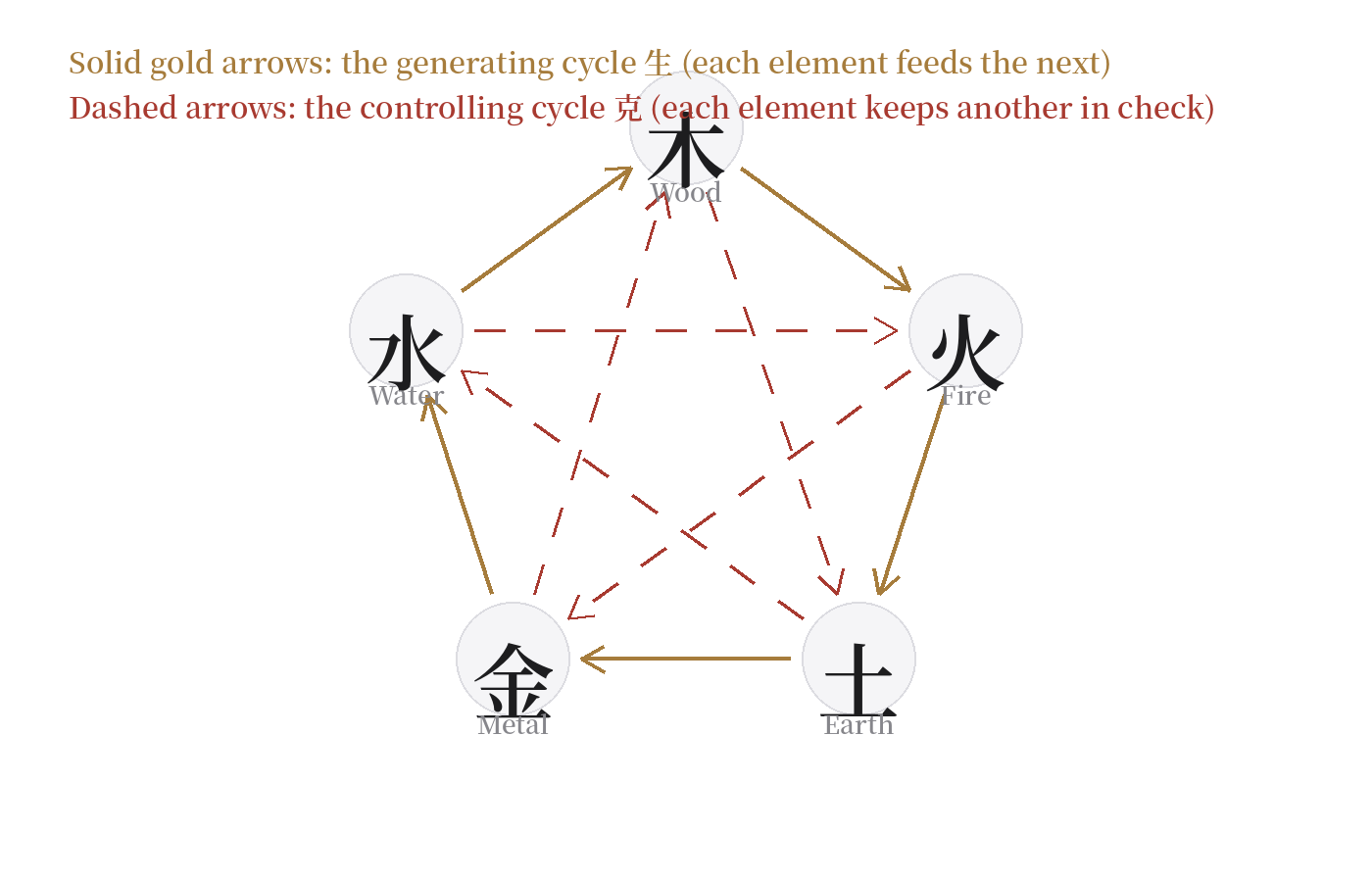
The classical texts also describe strength with a twelve-stage life cycle: birth, bathing, capping, official appointment, peak, decline, sickness, death, grave, extinction, womb, nurture. Each yang stem is born at a particular branch and walks these stages around the zodiac. Wood is born at the Pig, flourishes at the Rabbit, dies at the Horse. Fire is born at the Tiger and flourishes at the Horse. The stages are worth knowing about, and there are charts you can memorise, but for a first reading, season, roots and support will carry you ninety percent of the way. Do not let the extra two percent of theory stop you from reading at all.
Now the payoff question. Why does anyone care whether the Day Master is strong or weak? Because the remedy differs. A strong Day Master wants to be spent: given output, challenge, and meaningful resistance. The strong person who only accumulates and never gives becomes a jammed engine. A weak Day Master wants support: allies, the mother element, and achievable scopes. The weak person who keeps taking on battles built for the strong burns out on schedule. This is the honest core of BaZi advice, and notice that it is not mysticism at all. Know your raw material, and arrange your life so the material is used well. That is the whole craft, compressed into one sentence.
The ten gods: the grammar that powers every reading
Underneath the poetic names, BaZi runs on a piece of grammar so tidy it is almost bureaucratic. Take the Day Master’s element and polarity, then classify every other character in the chart by its relationship to that stem. Ten relationships are possible, five element interactions times two polarities, and tradition calls them the ten gods, 十神. Do not let the word god spook you; think job titles. Each character in your chart works one of ten jobs for the Day Master.
| Job title | Relationship | Governs | Example, for a Jia 甲 Day Master |
|---|---|---|---|
| Friend 比肩 | Same element, same polarity | Siblings, allies, self-discipline, stubbornness | Jia 甲 |
| Rival 劫财 | Same element, opposite polarity | Competitors, windfalls and losses, generosity that bleeds | Yi 乙 |
| Indirect Resource 偏印 | Mother element, same polarity | Intuition, unconventional learning, spiritual inclinations | Ren 壬 |
| Direct Resource 正印 | Mother element, opposite polarity | Education, mother, reputation, protection | Gui 癸 |
| Eating God 食神 | Output element, same polarity | Creativity, enjoyment, children, easy talent | Bing 丙 |
| Hurting Officer 伤官 | Output element, opposite polarity | Brilliance, rebellion, fame, sharp tongue | Ding 丁 |
| Indirect Wealth 偏财 | Wealth element, same polarity | Business income, windfalls, the father, risk appetite | Wu 戊 |
| Direct Wealth 正财 | Wealth element, opposite polarity | Salary, savings, the wife, diligence | Ji 己 |
| Seven Killings 七杀 | Power element, same polarity | Ambition, pressure, crises, decisive authority | Geng 庚 |
| Direct Officer 正官 | Power element, opposite polarity | Rank, institutions, the husband, discipline | Xin 辛 |
Read the right-hand column twice and the whole craft stops being mysterious. Notice that Direct Wealth is literally described as the wife for a male chart and Direct Officer as the husband for a female chart, in the classical convention. That is the basis of every marriage timing technique in the tradition: they are the job titles that govern partnership, and readers look at their condition. It also explains the tradition’s blind spots, and mine: these conventions were written by men about men’s charts several centuries ago, and modern readers have spent serious effort re-reading the same grammar for everyone. The relationships are universal; the social packaging is historical, and you are allowed to update the packaging without pretending the grammar does not work.
Three of the ten deserve special attention because they are the ones beginners fear and admire, always for the wrong reasons. Hurting Officer is the rebellious talent, and a chart with it healthy produces genuinely original people; a chart with it unbalanced produces criticism that solves nothing. Seven Killings is pressure itself, and charts that carry it well become commanders; charts crushed by it become anxiety with a job title. The Friend, meanwhile, is the quiet one: too many friends in a chart and the person cannot tell their own voice from the crowd’s, which is why strong charts with many allies are counselled to build, not to belong.
Here is the elegant part. Every one of these ten relationships appears in the chart as an actual character, and its condition tells you about that department of life. A wealth star that is rooted and unclashed suggests an honest relationship with money, the theme BaZi analysis: what you need to know unpacks from the practitioner’s side of the table. A power star that is beaten up by the rest of the chart suggests institutions will be a fight. Nothing is good or bad in isolation; the question is always condition, position and timing. This is why two charts with identical element counts can describe opposite lives, and why BaZi cannot be done by counting.
Clashes, combinations and the weather between pillars
The eight characters do not sit quietly in their columns. They react. Six pairs of branches clash, the technical word is 冲, and clashes are not always bad; a clash between a branch that serves the chart and one that damages it is a rescue, not a wound. What matters is who wins the argument, and the weather of the season decides that.
| Clash pair | Animals | Common classical theme |
|---|---|---|
| Zi and Wu 子午 | Rat and Horse | Water and fire, home and travel, rest and visibility |
| Chou and Wei 丑未 | Ox and Goat | Two kinds of earth, hidden grudges, storage opening |
| Yin and Shen 寅申 | Tiger and Monkey | Wood and metal, the classic collision of drive and critique |
| Mao and You 卯酉 | Rabbit and Rooster | Pure yin wood against pure yin metal, refinement by force |
| Chen and Xu 辰戌 | Dragon and Dog | Two stubborn earths, honour and provocation |
| Si and Hai 巳亥 | Snake and Pig | Fire and water, plans and scruples, the strategist’s clash |
Branches also combine. Neighbouring branches join in six pairs, like the Tiger and Horse combining into fire, and a combination can yoke two rivals into one team or drag a helpful character away from its post. There are also the three-part harmonies, the seasonal trines: Tiger, Horse and Dog assemble into a fire frame, and their meeting can change the element weather of the entire chart even without a single fire stem visible. This is the point where BaZi starts to feel like chemistry: the compounds do not resemble the ingredients, and the reaction needs conditions, namely the season and the presence of a catalyst character.
For your first year of study, do exactly what the classical authors tell apprentices to do. Watch one chart over twelve months, yours, and observe what happens in the months when a clash or combination arrives. Note what actually occurred, not what a fortune calendar promised. You will develop an instinct for the difference between a theoretical clash, which is nearly every one on the internet, and a live one, which changes the temperature of a week. That instinct is worth more than a hundred books, and no one can hand it to you.
Day Masters in love and in teams
People rarely ask about their careers first. They ask about people. Here is how the stems behave with each other, in the two contexts where it matters most.
In partnership, the productive pairings follow the mother-child flow of the elements, but with a caveat the feng shui shops will not tell you: the easy flow is not always the happy one. A Jia and a Gui, wood and water, can produce a decade of one-way nourishing in which the tree never once thanks the rain. Two Gengs, metal on metal, will spar constantly and defend each other ferociously, and outsiders will misread the sparring as trouble. The pairs people predict doom for, water and fire, produce the legendary partnerships of the tradition, when the fire is strong enough to be interesting to the water and the water is deep enough not to put it out. Chemistry in BaZi, as in life, is friction that has agreed on a direction.
On teams, a fast rule of thumb: strong stems need roles with resistance built in, and weak stems need roles with support built in, and most workplace misery I have seen diagnosed as personality conflict was actually role misassignment. A Wu mountain placed in a role that rewards quick pivots will be called slow. Place the same person where stability is the product, estates, compliance, crisis-aftermath, and they are called rock. I have stopped counting the managers who rediscovered a struggling employee by simply moving them one seat over in the system.
One more observation from the field, offered humbly. Stems of the same element recognise each other instantly, and the recognition runs both ways: instant kinship and instant rivalry, often in the same conversation. Two strong Bings in one organisation are either partners or competitors, and their friendship oscillates with who is currently shining. If you have ever met someone very like you and felt, within minutes, both understood and faintly threatened, you have already experienced this without any chart at all.
The decades: how luck pillars move through the chart
So far the chart has been a still photograph. It is actually a film. After the eight characters, BaZi adds the luck pillars, 大运, a sequence of pillars that rotates through the decades of life, one every ten years, derived from the birth data by a rule that is mechanical once you learn it: yang-year men and yin-year women count forward through the sexagenary sequence, and the others count back, starting from the month pillar. Nobody chooses their sequence; you are born into it the way you are born into a river’s current.
The practical meaning is this: the weather changes every ten years, roughly on a schedule you can read off the chart in your early twenties or discover the hard way at thirty-four. A person whose early luck pillars run through water and wood will spend their twenties being fed, educated, and softened; if their useful god is fire, those decades may feel oddly beige despite being objectively comfortable, because the chart is drinking what it does not want. Then a fire decade arrives at thirty-something and the same person suddenly becomes legible to themselves. I have watched this pattern enough times to stop treating it as coincidence, and the practitioners I respect describe the same thing in different vocabularies.
This also answers the question every beginner eventually asks: if the chart is fixed, what about change? The chart is the material; the decades are the weather. A sailing metaphor lands well here: you cannot change the wind, and you cannot change the boat, but you choose the sail and the heading, and two sailors in the same storm arrive at different ports. The luck pillars tell you when it is prudent to sail hard and when it is wise to stay in port and repair. People who fight the decade they are in, opening the aggressive venture in the consolidation decade, marrying in the scattered decade, tend to learn the lesson twice as expensively.
Use this wisely and modestly. A decade reading is a long-range forecast, not a verdict. And never let anyone tell you your next luck pillar requires the purchase of anything.
The useful god: what the chart actually needs
Season, roots and support give you a strength verdict. The next concept is what the chart is missing, and the classical name for it is the useful god, 用神. Shen Xiaozhan’s sentence about the month order was really about this. The useful god is the element, or the specific character, that brings balance to the whole picture. Find it and everything a reader says afterward is an elaboration of it.
Three classic cases cover most charts. A Day Master that is too strong needs the output element, to turn that surplus into expression, or the power element, to give it something worth opposing. A Day Master that is too weak needs its mother element, plain nutrition, or the same element, allies. And a chart whose real imbalance is a different element altogether, called the harsh god, needs the element that tames that harshness. The last one is why some readings are counter-intuitive: a day full of water might still need more water if fire is the thing destroying the chart’s structure. You do not treat the loudest symptom. You treat the pattern.
欲识三元万法宗,先观帝载与神功。
To know the ancestor of the ten thousand methods, first observe heaven’s carriage and the work of the spirits.
Liu Ji, Di Tian Sui (滴天髓), classical commentary by Ren Tieqiao
That is the famous opening line of Di Tian Sui, the most literary of the four classics, and generations of readers have disagreed about what it precisely means. My honest reading of it is this: before you drown in the ten thousand techniques, look at the whole picture first. The chart is a weather system, not a list of ingredients. A reading that counts elements like a scoreboard, then prescribes red underwear and a fish tank, is doing arithmetic while calling it medicine.
Which brings me to the question people always ask at this point: what about the year of the Rabbit, should I wear a rabbit pendant, my friend said to put a water fountain in my office. Feng shui adjustments and charm prescriptions exist at the edges of this tradition. Some of them are sensible, in that a person who is told to keep plants and actually keeps them has changed their environment, and their mood follows. Some are theatre. My suggestion: spend your seriousness on understanding the chart, not on shopping for it. The masters I respect all say the same thing in different words. The chart describes tendencies, and the work of a life is to arrange tendencies deliberately. Nobody has ever arranged a tendency with a keychain.
A complete reading, start to finish
Let us do a full walkthrough on a teaching chart. This is a constructed example, not a real person, so we can be candid. Here is the chart:
| Year pillar | Month pillar | Day pillar | Hour pillar | |
|---|---|---|---|---|
| Heavenly Stem | Jia 甲 | Bing 丙 | Jia 甲 | Geng 庚 |
| Earthly Branch | Chen 辰 | Yin 寅 | Zi 子 | Wu 午 |
Step one: identify the Day Master. The stem of the Day Pillar is Jia, yang wood, the big tree. Everything is read from Jia’s perspective.
Step two: check the season. The month branch is Yin, the Tiger, the first month of spring. Wood is in season, and this is Jia’s own power position; the Tiger is where wood establishes its influence. The season verdict is unambiguous: the tree grows in spring.
Step three: count the roots and support. Yin hides Jia wood as its main hidden stem, a strong root right in the month. The year branch Chen hides Yi wood, a minor root. The day branch Zi is water, the mother element, sitting directly under the Day Master like groundwater under the trunk. The month stem Bing fire is output, and the year stem Jia is an ally standing in plain sight. Only the hour stem Geng metal, the axe, opposes the tree.
Step four: verdict on strength. The evidence is lopsided. In season, rooted twice, watered directly, with an ally: this is a strong Jia. The Geng metal in the hour pillar would like to prune the tree, but autumn tools are weak in spring. Metal sitting on a Horse branch, in a chart flooded with wood energy, has no support at all.
Step five: find the useful god. Strong wood wants spending, not more feeding. The chart already offers Bing fire, the sun, right in the month stem, and Wu fire, the Horse, in the hour branch. Fire is expression, achievement, visibility. That is the healthy outlet for all this springtime energy. The reading of this person writes itself now: substantial raw material, born into advantage, with the real risk of becoming the immovable oak who will not be pruned. The remedy is to live in the fire, meaning work that expresses and exhausts the strength, creative and public, rather than accumulating titles. The Geng metal in the hour is actually a blessing in disguise, once it gains some support in later decades: the tree that finally meets the axe becomes timber.
Step six: read the pillars as life stages and rooms. Year pillar, ancestors and early environment: ally wood on Dragon ground, a supportive, sturdy childhood. Day pillar, self and marriage: water under the tree, a spouse who is the quiet nourisher, which strong wood people need more than they admit, or the marriage becomes a shadeless field. Hour pillar, children and later years: the axe and the fire, a demanding, forging, productive second half of life.
Notice what we did not do. We did not say you will be rich in the year of X. The chart describes architecture, not appointments, the same lesson the parallel method of interpreting a BaZi chart through Qi Men Dun Jia keeps arriving at from the other direction. A good reading tells you what the house is made of, which way the doors open, and which room gets the morning sun. You still decide what to do inside it.
Where readings go wrong: six honest mistakes
Before the classics and the FAQ, a warning label. These are the errors I see most often, in beginners and in professionals.
Mistake one: sun-signing your Day Master. Reading the ten stem portraits above as fixed personalities is the same error as reading sun signs. The portrait is raw material, and strength, season and combinations change everything. A weak Ding and a strong Ding share a fuel type, not a life.
Mistake two: counting elements like a scoreboard. Four woods, so I need metal, so I will wear white and put a knife under the bed. Charts are relationships, not totals. Two characters in combination can matter more than three scattered ones.
Mistake three: clock time instead of solar time. Half the charts I am asked to double-check are built on the wrong hour, and a startling number on the wrong year because of the Li Chun boundary. If your reading has ever felt flat, rebuild the chart with a tool that asks for your city, not just your time zone.
Mistake four: the missing hour. One character in eight is missing, and the hour pillar governs the later decades and the private self. Readings without a birth hour are sketches, and honest readers say so. Some practitioners reconstruct the hour by testing life events against all twelve candidates, which is a real technique, but it is an estimate, and should be labelled one.
Mistake five: fortune-telling. Declaring the future as settled fact is not the craft. It is a parody of the craft that damages people, in both directions, by assigning false hope or false doom. The classical texts themselves are full of caution about overreach. Anyone who tells you a chart guarantees an outcome is skipping four centuries of their own tradition’s argument about that.
Mistake six: skipping the Day Master entirely. The western habit is to jump straight to wealth stars and marriage stars. Without the Day Master’s strength and season, those stars are unreadable. The same wealth star that makes a strong chart rich buries a weak one.
The four classical books worth knowing
If you want to go past articles and into the tradition, these are the four sources. All are available in Chinese, and English translations of varying quality circulate; the translator matters as much as the author.
Yuan Hai Zi Ping (渊海子平) is the founding compilation, assembled in the Song dynasty from the method attributed to Xu Ziping, who moved the craft’s centre of gravity from the year pillar to the day stem. That single move, day over year, is the birth of the system this article describes. Every later book is a footnote to it.
Zi Ping Zhen Quan (子平真诠), by Shen Xiaozhan of the Qing dynasty, is the great book on structure and the useful god, and the source of the month-order teaching above. It is the most orderly of the four, the natural second book after this article.
Di Tian Sui (滴天髓) is the most poetic and the most admired by professionals. Short, aphoristic, sometimes maddening, it treats strength and weakness as the central axis of reading, which is why I quoted it twice. Ren Tieqiao’s Qing-era commentary turned it into a complete course.
Qiong Tong Bao Jian (穷通宝鉴) is the seasonal manual: for each stem in each month, what is needed. It reads almost like an almanac, and it is where the image of the tree needing fire to flower, water to drink, and an axe to become timber comes from. Study it after the other three, not before, because it assumes you know how to weigh the whole chart.
A note on lineage. Practitioners disagree, sometimes sharply, about yin stem stages, about how to rank the hidden stems, about which school of the useful god is correct. That is not a weakness of the tradition; it is a sign of a living one. Be suspicious of anyone claiming the one true method, including in Chinese, especially with a course to sell.
Questions people actually ask
How accurate is BaZi, honestly? As a language of patterns, it is startlingly specific once built correctly. As a predictor of events, it is probabilistic at best. My own view, after years around it: its value is not prophecy, it is self-observation with unusually good vocabulary.
My birth time is unknown. Is there any point? Yes, but a smaller one. The six known characters still describe season, strength and structure, which is also where most of the value lives: see why people go for BaZi reading for what people are usually searching for under all of it. Ask any reading to be honest about that ceiling.
What about twins born in the same hour? Same chart, different lives, and every serious tradition has answers: the minute-level hour branch boundaries, family role differences, later name and environment. I find the honest answer is that the chart describes the hand of cards, and twins play the same hand differently.
Is this fortune-telling or psychology? It is a symbolic system that predates the split between those words. Whether the five elements are real forces or a very good filing cabinet, I leave to your metaphysics. Filing cabinets that make you see yourself clearly are worth having.
Can I learn this myself? Yes. This article plus the four classics plus a hundred practice charts, and you will read better than most people charging money. The craft rewards patience more than talent.
Should I change my name, buy things, or repaint my room based on this? Understand the chart first. If an adjustment afterwards helps you act deliberately, fine, but the change happens in the behaviour, not the object. A red wallet has never made anyone brave.
Related reading on this site
If the Day Master gave you a taste for the grammar of Chinese metaphysics, these go deeper: using QMDJ to interpret a BaZi chart, the honest distinction between BaZi and Feng Shui, why people actually go for BaZi readings, and for the full toolkit, the Qi Men destiny chart in the modern world.
The newest flagships go wider still: casting and reading the I Ching, classical date selection, and what happens during a real feng shui audit.
The last word
The Day Master is one character among eight, and it is the one the other seven are arranged around. Learn your own: the raw material, the season it was born into, whether it is rooted or exposed, what feeds it, and what it is asking to become. Then be more careful with it than a stranger would be.
That, in the end, is what a good BaZi reading is for. Not to tell you who you are, because you already suspect that, but to say the quiet part in precise language: here is the material, here is the weather, here is the sensible direction of growth. The tree does not argue with spring. It grows in it.
A twelve-month practice plan
If you want to leave this article with a skill rather than a reading, here is the honest curriculum I would give a serious student, compressed into one year. It assumes you have a full-time life and no teacher yet.
Months one to three: learn to build charts correctly. Ignore interpretation entirely. Practise until you can look at a birth date, a time and a city and predict what the four pillars should look like before the software confirms it, especially the tricky edges: January and early February births, evening births around the 11pm boundary, and people born in the last days of a season. Get ten charts from friends, with birth certificates where possible. The goal is that no calculator can hand you a wrong chart without you noticing.
Months four to six: read for pattern, not prophecy. Take those ten charts and do only one thing per chart: verdict on strength, season, roots, then one sentence on what the useful god probably is. Write the sentences down and revisit them later. You are training the core reflex of the craft, which is that every other judgement hangs from that single verdict. If you feel tempted to tell a friend which year they will marry, you are ahead of schedule and should slow down.
Months seven to nine: the ten gods in live charts. Now walk each chart and label the job titles. Whose wealth star is rooted, whose power star is besieged, whose output is crushed. Practise on charts of people whose lives you actually know, because the feedback is honest and immediate. The first time you point at a stranger’s chart and accurately describe their relationship with their father from the position of one stem, you will understand why people keep studying this.
Months ten to twelve: the classics, in order. With a year of pattern-reading behind you, the four classical books stop being cryptic and start being dense. Read Zi Ping Zhen Quan first for structure, Di Tian Sui second for the depth of the strength teaching, then the seasonal tables of Qiong Tong Bao Jian. Yuan Hai Zi Ping you consult rather than read, the way you consult a founding legal text. Find one practitioner community that argues, and argue politely. The tradition is four thousand disagreements deep, and yours are welcome.
That is the whole path. Not one step of it requires believing anything supernatural; every step requires watching closely, which is the rarest skill of all.
The FAQ people ask me, as a final section
Does everyone with the same Day Master have the same personality? No. Roughly one in ten people share your stem, and they also share a season, a strength verdict and a set of job titles with almost nobody. The stem is the instrument; the chart is the music.
Can two people have identical charts? The full eight characters repeat in the calendar every few decades for the same region, and yes, strangers have. This is the tradition’s own honest answer to its sceptics: identical chart, different life, and the difference is the whole argument of this article, structure versus choice.
Are some Day Masters luckier than others? The stems are materials, and materials are only good or bad relative to a job. The classical authors’ favourite illustration is a chart full of noble metal with nobody to refine it: a Xin jewel in a box. Meanwhile a plain Ji soil that happens to sit in a garden chart is worth more than the jewel. There are no bad stems. There are bad fits.
What does a professional reading add that this article does not? Speed, from having seen a thousand charts, and accountability, since they will say what a friend will not. What it should never add is mystique. If your reader cannot explain their verdict in plain language the way this article has tried to, they are not a master of the craft, only of the theatre around it.
Is BaZi compatible with my religion, or with science? It is compatible with carefulness, and I mean that literally. The classical texts were written by people arguing with each other in good faith about observations. Whether you file those observations under cosmology, psychology, or interesting folklore is a personal choice, and the chart does not care how you file it. Treat it as a lens you own, not a doctrine that owns you, and it will repay you generously.
Leave a Reply
You must be logged in to post a comment.