The I Ching as a Decision Mirror: How 64 Hexagrams Hold Up a Mirror to Your Mind
At 2:15 AM on a rainy Tuesday, my friend Wei Ming sat at his kitchen table in Seattle with a cold cup of black coffee, three worn copper coins, and a blank notebook. He had spent six months debating whether to leave his comfortable engineering role at a software giant to join a fragile series-A startup as co-founder. His mind was an exhausted loop of pros, cons, equity math, and panic. Desperate for a circuit breaker, he set three coins in his palm, closed his eyes, and tossed them onto the wood. The coins clattered, spun, and settled: heads, heads, tails. An 8: static yin. He wrote down a broken line at the bottom of his paper. (Wei Ming is a real composite of several engineers I have coached, but his dilemma and this exact consultation are constructed to show you how the mechanics work.)
Pull back from that quiet kitchen table for a moment. What was Wei Ming actually doing? If you ask a pop-culture enthusiast, he was engaging in superstitious fortune-telling, hoping a set of ancient Chinese coins would predict whether his startup equity would turn into millions. That view completely misinterprets the text. The I Ching, or Zhouyi (周易), does not predict fixed futures because classical Chinese cosmology never viewed the future as a hard-coded script waiting to play out on a screen. Instead, the tradition sees the universe as an interconnected field of shifting conditions governed by constant principles of polarity, transformation, and cyclical return.
Unlike Western predictive systems like astrology or popular tarot decks, which often focus on external events, personality types, or fatalistic outcomes, the I Ching operates as a dynamic vector analysis tool. It does not tell you what will happen; it tells you what conditions currently exist and how force moves through those conditions. The difference is profound. Predicting that a ship will sink leaves you helpless; analyzing water turbulence and hull integrity allows you to change course before hitting the reef.
When you toss coins or divide yarrow stalks, you are not summoning ghosts or tapping into supernatural magic. You are using a 3,000-year-old binary structural system as a cognitive mirror. Human decisions suffer terribly from emotional blind spots, confirmation bias, sunk-cost fallacies, and defensive rationalization. When a tough choice haunts you, your brain locks onto a preferred narrative, filtering out warning signs and suppressing quiet misgivings. Casting a hexagram forces an immediate, deliberate pause. It introduces an external symbolic structure that demands you evaluate your situation from an unexpected angle, disrupting your mental ruts and forcing you to confront uncomfortable realities you had swept under the rug.
To appreciate how this mirror functions, look at how the text evolved over three millennia. Long before paper or written books existed, diviners in the Shang Dynasty (c. 1600 to 1046 BCE) practiced scapulimancy, heating ox shoulder blades and turtle shells with red-hot pokers until the bone cracked, interpreting the fissures for royal decisions regarding military campaigns, harvests, and royal health. By the Western Zhou Dynasty (1046 to 771 BCE), diviners replaced bone-burning with a cleaner mathematical system using dried yarrow stalks. King Wen of Zhou and his son, the Duke of Zhou, assigned core judgements and line texts to sixty-four binary line stacks. Centuries later, during the Warring States period, Confucius and his philosophical school added philosophical commentaries known as the Ten Wings (Shi Yi 十翼), transforming a ritual manual into a profound philosophical framework for human governance, ethics, and self-cultivation.
At the center of this framework operates the dynamic interplay of yin and yang. Yin (⚋) represents receptivity, quietness, interior reflection, absorption, consolidation, and yielding to force. Yang (⚊) represents creativity, activity, exterior projection, initiative, structure, and expansive strength. Neither pole is superior, virtuous, or permanent. They are complementary phases of a continuous cycle, like night turning into day, winter giving way to spring, or market contraction preceding a growth cycle.
一阴一阳之谓道
“One yin and one yang constitute the Way.”
Xi Ci Zhuan (系辞传 / Great Commentary)
This core passage from the Great Commentary captures the operational core of the entire text. Everything in human experience fluctuates between these two poles. When an aggressive expansion strategy reaches its physical or financial limit, it collapses into receptivity; when a quiet period absorbs enough energy and resources, it erupts into outward motion. If you approach the text expecting passive comfort or magical predictions, you will be disappointed. The I Ching demands active participation, rigorous thinking, and personal agency. It does not make your decisions for you; it maps the structural terrain so you can navigate through it with your eyes wide open.
Consider how this applies to modern professional life. A startup founder pushing relentlessly for rapid growth is operating in pure yang mode. If they ignore the need for yin consolidation (building operational infrastructure, stabilizing cash flow, and training staff), the system overextends and collapses. Conversely, an established corporate division that spends years in pure yin reflection without launching new initiatives eventually suffocates from stagnation. The Book of Changes teaches you to recognize which phase of the cycle you inhabit so you can align your posture with the prevailing direction of force.
Formulating the Query: Stop Asking the Coins What to Do
Eight out of ten useless I Ching readings are ruined before the coins ever touch the desk. The failure does not happen when you flip the metal; it happens when you write down the question.
When Wei Ming first sat down at his kitchen table, his initial impulse was to ask: “Will this startup make me rich this year?” That is a textbook bad query. First, it assumes life is a pre-recorded movie waiting for you to hit play. Second, it strips away your personal agency, turning you into a passive spectator hoping for good luck. If the coins give an encouraging answer, you get lazy and complacent; if they give a grim answer, you fall into anxiety and despair. In both cases, your practical decision-making capacity degrades.
Another classic mistake is asking binary ultimatums, such as: “Should I quit my job today or stay for another five years?” The I Ching does not give binary yes-or-no answers, nor does it choose between two mutually exclusive external options in a single cast. Trying to force two competing career paths into one coin toss creates an ambiguous mess that leaves you more confused than when you started.
Effective queries are open-ended, process-oriented, and focused on personal agency and strategic alignment. Instead of asking what will happen to you, ask about the nature of the situation, the hidden forces at play, and your optimal operational posture. Consider how bad questions can be transformed into clear, actionable queries across different life domains:
-
Career and Business Transitions:
Poor Query: “Will my new business venture succeed?”
Refined Query: “What is the strategic nature of the situation and optimal operational posture if I launch the new enterprise during Q4?” -
Relationships and Interpersonal Dynamics:
Poor Query: “Does Alex secretly love me?”
Refined Query: “How can I cultivate emotional clarity and honest communication in my relationship with Alex over the next three months?” -
Personal Growth and Life Direction:
Poor Query: “Why am I so burnt out and unhappy?”
Refined Query: “What internal dynamics and behavioral patterns are contributing to my current exhaustion, and how can I restore balance?” -
Financial and Investment Strategy:
Poor Query: “Should I buy this volatile tech stock right now?”
Refined Query: “What risk factors and structural conditions should I evaluate before allocating capital to this market sector?” -
Organizational Leadership:
Poor Query: “Will my team accept this new restructuring plan?”
Refined Query: “How can I structure communication and alignment to guide my team through the upcoming organizational change?”
Before you pick up your coins, spend ten minutes writing your question down by hand. Edit the wording until it is crisp, honest, and completely free of hidden self-deception. If you notice yourself trying to tilt the wording to extract a flattering response, stop immediately and rewrite it. The mirror only reflects clearly when the surface is clean.
Establishing clear operational scope is equally vital. If you ask a broad, unconstrained question like “How is my life going?”, you will receive a broad, abstract response that is almost impossible to apply to concrete choices. Bound your question by time, context, and domain. Focus on the next quarter, the current project, or a specific strategic initiative. When Wei Ming finally refined his query, he wrote: “What is the strategic nature of the situation and optimal operational posture if I initiate a full microservices architectural rewrite during Q4?” Notice how specific that is. It specifies the initiative, the technical scope, and the exact timeframe. That level of precision gives the symbolic mirror something solid to reflect.
The Mechanics of Binary Building: How Stacking Six Lines Maps the World
Why six lines? Why not four elements, twelve zodiac signs, or five planet alignments?
The structural language of the I Ching is built entirely on a binary system, designed three thousand years before modern computer architecture. Every hexagram consists of six stacked lines, built strictly from the bottom up. A solid line (⚊) represents yang energy, while a broken line (⚋) represents yin energy. By stacking these two basic units in combinations of three, the ancient diviners created the eight fundamental trigrams (Ba Gua 八卦). By stacking two trigrams together, they created the sixty-four hexagrams ($2^6 = 64$).
To read hexagrams with real depth, you must master the eight trigrams. Each trigram represents a natural element, a familial role, an anatomical association, a cardinal direction, and a psychological archetype. The table below outlines the core properties of all eight fundamental building blocks:
| Trigram Symbol | Trigram Name | Chinese Character | Natural Element | Family Member | Body Part | Compass Direction |
|---|---|---|---|---|---|---|
| ☰ | Qian (The Creative) | 乾 | Heaven / Sky | Father | Head | Northwest |
| ☷ | Kun (The Receptive) | 坤 | Earth / Soil | Mother | Abdomen | Southwest |
| ☳ | Zhen (The Arousing) | 震 | Thunder | Eldest Son | Feet / Legs | East |
| ☴ | Xun (The Gentle) | 巽 | Wind / Wood | Eldest Daughter | Thighs / Buttocks | Southeast |
| ☵ | Kan (The Abyssal) | 坎 | Water / Moon | Middle Son | Ears / Kidneys | North |
| ☲ | Li (The Clinging) | 离 | Fire / Sun | Middle Daughter | Eyes / Heart | South |
| ☶ | Gen (Keeping Still) | 艮 | Mountain | Youngest Son | Hands / Spine | Northeast |
| ☱ | Dui (The Joyous) | 兑 | Lake / Marsh | Youngest Daughter | Mouth / Tongue | West |
When two trigrams combine into a hexagram, the lower trigram (lines 1, 2, and 3) represents your inner world, your subjective state, and your foundational environment. The upper trigram (lines 4, 5, and 6) represents the outer world, the objective environment, and public institutional conditions.
The position of each individual line within the stack also carries specific organizational and tactical meaning. Line positions are counted starting from the bottom up:
- Line 1 (Bottom): The initial emergence of the situation, early entry, foundational stage, low rank, or internal thoughts before taking public action. Metaphorically, this is the stealth prototype or private proposal stage.
- Line 2: Emerging strength within the inner sphere, official position in the lower organization, or balanced conduct. Line 2 stands in direct structural harmony with Line 5. Metaphorically, this is the ground-level product manager or team lead executing operational work.
- Line 3: The boundary transition between inner and outer realms. A position of high tension, pressure, and potential overreaching where rash moves cause immediate trouble. Metaphorically, this is the scaling crunch where local success faces institutional scrutiny.
- Line 4: Entry into the outer institutional realm. The position of an executive advisor, senior staff member, or trusted vice president operating near the center of power. Metaphorically, this is executive alignment and policy coordination.
- Line 5: The primary position of authority, executive leadership, or peak development. This is the ruler line that governs the overall hexagram. Metaphorically, this is the chief executive or founder setting strategic direction.
- Line 6 (Top): The ultimate limit of the situation, transition out of the hexagram, or peak development turning into exhaustion, arrogance, or wise retirement. Metaphorically, this is the chairperson or advisor watching the end of a cycle.
Beyond primary trigrams, experienced practitioners analyze nuclear hexagrams (Huo Gua 互卦) to uncover hidden internal pressures within a situation. A nuclear hexagram is constructed by taking lines 2, 3, and 4 of your primary hexagram to form a new lower trigram, and lines 3, 4, and 5 to form a new upper trigram. For example, if your primary hexagram is Hexagram 11 (Tai / Peace), lines 2, 3, and 4 form Zhen (Thunder), and lines 3, 4, and 5 form Dui (Lake), creating Nuclear Hexagram 54 (Gui Mei / The Marrying Maiden). This reveals that beneath surface peace lies volatile emotional momentum that requires careful management. If your surface hexagram looks peaceful but its nuclear hexagram contains dangerous water or mountain trigrams, latent structural stress is brewing beneath the surface.
Line resonance (Ying 应) and correct position (Dang Wei 当位) add further analytical depth. Solid yang lines are correctly placed in odd positions (1, 3, 5), while broken yin lines are correctly placed in even positions (2, 4, 6). When a line occupies its correct position, its energy is structurally balanced; when out of position, friction occurs. Furthermore, line 2 resonates with line 5, line 1 resonates with line 4, and line 3 resonates with line 6 when one line is solid yang and the other is broken yin. This structural resonance mirrors how junior practitioners find alignment with senior executives in complex organizations.
Always build your hexagram from line 1 upward to line 6. Physical construction direction mirrors natural growth. A tree grows from its roots up to its canopy, and an architectural foundation precedes its roof. Stacking your lines from the ground up anchors your mind in that organic sequence.
The Coin Method: A No-Nonsense Guide to Flipping Copper
Clear your workspace. You do not need silk robes, sandalwood incense, or an altar facing north. You need three coins of identical size and weight, a pen, and paper.
While traditionalists argue about ancient yarrow stalks, three physical coins provide a clean, reliable, and accessible casting protocol. You can use traditional bronze Chinese cash coins with square holes or three standard modern coins like quarters or nine-pence pieces. The vital rule is consistency: all three coins must share the exact same weight and dimensions so every toss remains mathematically fair and physically balanced.
Before throwing your coins, assign unambiguous numerical values to each side:
- Tails Side (Yin Value): Assign a numerical value of 2 (representing soft, receptive, even energy)
- Heads Side (Yang Value): Assign a numerical value of 3 (representing hard, active, odd energy)
Hold all three coins loosely in both hands. Take a moment to focus your attention on your written question sitting on the desk. Shake the coins gently between your palms, letting your mental noise settle, and cast them onto a flat surface. Sum the numeric values of all three coins to determine the line type:
- Three Tails (2 + 2 + 2 = 6): Old Yin. A broken line that is changing or transforming into yang (⚋ ➔ ⚊).
- Two Tails + One Head (2 + 2 + 3 = 7): Young Yang. A static, stable solid line (⚊).
- One Tail + Two Heads (2 + 3 + 3 = 8): Young Yin. A static, stable broken line (⚋).
- Three Heads (3 + 3 + 3 = 9): Old Yang. A solid line that is changing or transforming into yin (⚊ ➔ ⚋).
Repeat this process six times in total. Record each toss immediately on paper, starting at the bottom of the page for Toss 1 and moving upward to Toss 6 at the top. Here is how a completed six-toss sequence looks on paper:
- Toss 6 (Top / Line 6): Heads, Tails, Tails (3 + 2 + 2 = 7) -> Static solid line: ⚊
- Toss 5 (Line 5): Heads, Heads, Tails (3 + 3 + 2 = 8) -> Static broken line: ⚋
- Toss 4 (Line 4): Heads, Tails, Tails (3 + 2 + 2 = 7) -> Static solid line: ⚊
- Toss 3 (Line 3): Heads, Heads, Tails (3 + 3 + 2 = 8) -> Static broken line: ⚋
- Toss 2 (Line 2): Heads, Heads, Heads (3 + 3 + 3 = 9) -> Moving solid line: ⚊ (mark with an O)
- Toss 1 (Bottom / Line 1): Heads, Tails, Tails (3 + 2 + 2 = 7) -> Static solid line: ⚊
Once all six lines are drawn, you have your Primary Hexagram. Any lines with values of 6 or 9 are moving lines. In the example above, Line 2 (Old Yang 9) is changing, while the remaining five lines remain static.
Keep your physical workspace organized and uncluttered. If a coin rolls off your desk onto the carpet or lands precariously on its edge against a book, do not guess its value or flip it over with your finger. Pick up all three coins, take a breath, refocus on your written query, and re-cast that specific line. Do not restart the entire consultation from Line 1; simply repeat the toss for the line that was physically disrupted.
Some diviners ask whether the physical composition of the coins matters. Traditional bronze coins carry historical charm, but nickel, copper, or silver work equally well. The magic resides in your psychological commitment to the process, not in the metallurgy of the currency. The physical act of holding metal, shaking it, and reading numbers anchors your physical body in the present moment, cutting through abstract anxiety.
The Yarrow Stalk Method: Ancient Ritual, Stalk Counting, and Hidden Odds
I distrust yarrow purists, and here is why. Many traditionalists act as if holding fifty dried stalks of Achillea millefolium automatically makes them wiser than someone flipping copper quarters. They spend forty-five minutes on elaborate hand manipulations, convincing themselves that slow equals holy. Yet beneath the ritualism lies a fascinating mathematical truth that most purists cannot even explain: the odds of getting a moving line with yarrow stalks are completely different from flipping coins.
Before coins became popular during the Tang and Han dynasties, diviners used dried yarrow stalks to consult the Zhouyi. The traditional yarrow procedure, recorded in the Great Commentary (Xi Ci Zhuan), follows a mathematical routine called the Dayan method. You start with fifty stalks, set one stalk aside in a wooden holder (representing the central unity of the cosmos), and work with the remaining forty-nine stalks through three distinct cycles for every single line:
- First Cycle: Divide the forty-nine stalks into two random piles (representing Heaven and Earth). Take one stalk from the right-hand pile and insert it between the ring finger and pinky of your left hand (representing Man). Count off the left pile by fours until four or fewer stalks remain, placing that remainder between your middle and ring fingers. Count off the right pile by fours, placing that remainder between your index and middle fingers. The sum of all held remainder stalks will always be 5 or 9. Set those remainders aside.
- Second Cycle: Gather the remaining 44 or 40 stalks, divide them into two piles, and repeat the exact same division process. The sum of held remainder stalks will always be 4 or 8. Set those remainders aside.
- Third Cycle: Gather the remaining stalks, divide them into two piles, and repeat the process a third time. The sum of remainders will again be 4 or 8. Set those remainders aside.
After completing all three cycles for one line, count the total remaining stalks in your main bundle. The count will always be 24, 28, 32, or 36 stalks. Dividing that final number by 4 yields your line value: 6 (Old Yin), 7 (Young Yang), 8 (Young Yin), or 9 (Old Yang).
Why use yarrow stalks when three coins take thirty seconds? Beyond the meditative state induced by counting stalks, the true difference lies in probability distribution. When flipping three coins, each outcome follows a symmetric binomial distribution ($1/2 imes 1/2 imes 1/2 = 1/8$ per coin combination):
- Coin 6 (Old Yin): 1 in 8 chance (12.50%)
- Coin 7 (Young Yang): 3 in 8 chance (37.50%)
- Coin 8 (Young Yin): 3 in 8 chance (37.50%)
- Coin 9 (Old Yang): 1 in 8 chance (12.50%)
The yarrow stalk division process produces an asymmetric probability distribution. Because of how remainders accumulate across three cycles, the probabilities for line values shift significantly:
- Yarrow 6 (Old Yin): 1 in 16 chance (6.25%)
- Yarrow 7 (Young Yang): 5 in 16 chance (31.25%)
- Yarrow 8 (Young Yin): 7 in 16 chance (43.75%)
- Yarrow 9 (Old Yang): 3 in 16 chance (18.75%)
The table below provides a side-by-side comparison of the mathematical probabilities for both casting methods:
| Line Value | Line Type & Character | Coin Probability | Coin Percentage | Yarrow Probability | Yarrow Percentage | Structural & Practical Meaning |
|---|---|---|---|---|---|---|
| 6 | Old Yin (Changing ⚋ ➔ ⚊) | 1 / 8 | 12.50% | 1 / 16 | 6.25% | Rare in yarrow. Represents extreme yin reaching maximum density and collapsing into yang. |
| 7 | Young Yang (Static ⚊) | 3 / 8 | 37.50% | 5 / 16 | 31.25% | Stable, active strength that maintains its current form without imminent transformation. |
| 8 | Young Yin (Static ⚋) | 3 / 8 | 37.50% | 7 / 16 | 43.75% | Most common yarrow result. Receptive, stable field that absorbs force without changing. |
| 9 | Old Yang (Changing ⚊ ➔ ⚋) | 1 / 8 | 12.50% | 3 / 16 | 18.75% | Three times more common in yarrow than Old Yin. Active expansion reaching its outer limit. |
Notice the cosmological implications of these numbers. In the yarrow stalk method, Old Yang (9) occurs three times as often as Old Yin (6). Traditional scholars interpret this asymmetry as reflecting classical Chinese physics: yang energy is active, expansive, and unstable, reaching its limit and transforming quickly. Yin energy is dense, receptive, and stable, enduring far longer before undergoing complete structural shift. When you cast coins, you are using a perfectly balanced mathematical wheel; when you count yarrow stalks, you are working with an asymmetric cosmic bias.
Moving Lines and Transformations: When the Ground Shifts Beneath Your Feet
Imagine standing on a frozen lake in early spring. Static lines are thick ice that holds your weight without a sound. A moving line is a sharp crack radiating across the surface beneath your boots.
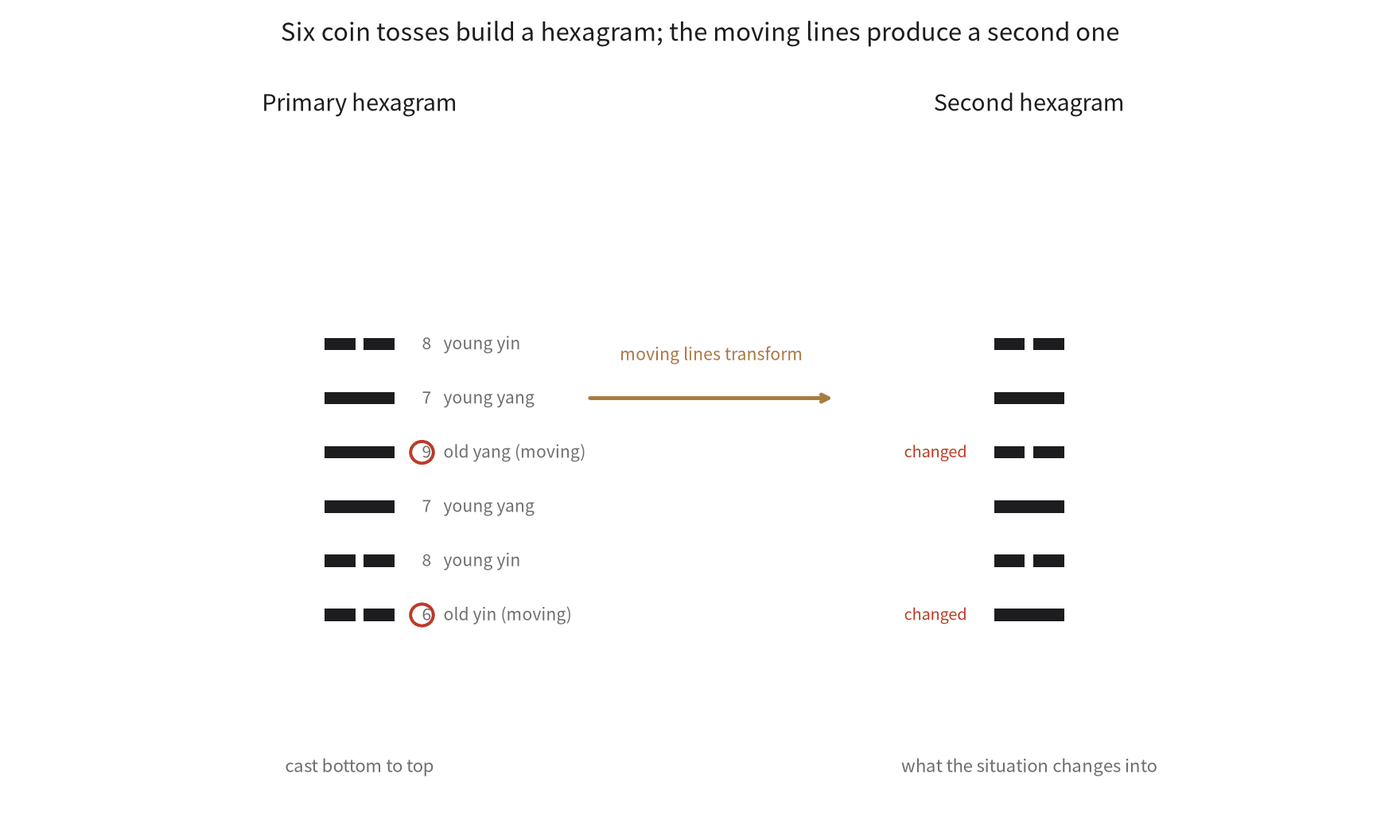
When you cast a hexagram, you will frequently encounter lines with values of 6 or 9. These are moving lines, changing lines, or old lines. A static line (7 or 8) stays put; a moving line has reached its operational limit and must transform into its polar opposite. An Old Yin line (6) turns into a Young Yang line (⚊), and an Old Yang line (9) turns into a Young Yin line (⚋).
The presence of moving lines gives birth to two distinct hexagrams in a single consultation:
- The Primary Hexagram (Original State): Built directly from your six toss values. It represents your current situation, immediate environment, and present baseline conditions.
- The Secondary Hexagram (Resultant State): Derived by flipping every moving line to its opposite while leaving all static lines unchanged. It represents the prospective outcome, future trajectory, or eventual state toward which your situation evolves.
The table below summarizes the line values, symbols, and transformation rules for quick reference:
| Numeric Value | Primary Line Symbol | Line Name | Primary Line Quality | Transformed Symbol | Secondary Quality | Interpretive Focus |
|---|---|---|---|---|---|---|
| 6 | ⚋ (marked X) | Lao Yin (Old Yin) | Moving / Changing Yin | ⚊ | Young Yang | Receptive limit reached; shifting toward active expression and leadership. |
| 7 | ⚊ | Shao Yang (Young Yang) | Static Yang | ⚊ | Young Yang | Stable, persistent force; maintain current course with quiet determination. |
| 8 | ⚋ | Shao Yin (Young Yin) | Static Yin | ⚋ | Young Yin | Stable receptivity; observe, support, and absorb without forcing progress. |
| 9 | ⚊ (marked O) | Lao Yang (Old Yang) | Moving / Changing Yang | ⚋ | Young Yin | Overextended drive; force spent; must yield, rest, and accept boundary. |
Change is not an anomaly to be feared; it is the fundamental mechanism of existence. The Great Commentary emphasizes this structural reality:
穷则变,变则通,通则久
“When things reach their limit, they change; change leads to flow; flow endures.”
Xi Ci Zhuan (系辞传 / Great Commentary)
Interpreting readings with multiple moving lines can confuse beginners. If three or four lines are changing simultaneously, which text should you read first? Song Dynasty scholar Zhu Xi established clear guidelines for reading consultations based on moving line counts:
- Zero Moving Lines: Read only the Judgement (彖辞) and Image (象辞) of the Primary Hexagram. The situation is stable and focused on the primary theme.
- One Moving Line: Read the Judgement of the Primary Hexagram, but place your primary focus on the specific line statement for that changing line. That line pinpoints your immediate decision.
- Two Moving Lines: Read the line statements for both moving lines in the Primary Hexagram. Focus primarily on the upper moving line, using the lower moving line as supporting background.
- Three Moving Lines: Read the Judgements for both the Primary Hexagram and the Secondary Hexagram. The situation is in major transition, balanced halfway between present state and future trajectory.
- Four Moving Lines: Read the two static (non-moving) lines in the Secondary Hexagram, focusing primarily on the lower static line. The future state has taken over, and static lines show where stability remains.
- Five Moving Lines: Read the single static line in the Secondary Hexagram. That single non-changing line holds the key to navigating the transformation.
- Six Moving Lines: Read the Judgement of the Secondary Hexagram. (For Hexagram 1 Qian and Hexagram 2 Kun, read their special extra texts: “All Nines” or “All Sixes”).
Advanced diviners also examine complementary structural perspectives alongside the secondary hexagram. The inverted hexagram (Fan Gua 反卦), created by turning the primary hexagram upside down, shows how your situation appears from an opponent’s or counterparty’s perspective. The opposite hexagram (Pang Tong Gua 旁通卦), created by flipping every single line to its opposite, reveals the polar antithesis of your current state. Evaluating these structural perspectives provides 360-degree situational awareness.
Reading Classical Commentaries: Unpacking Judgements, Images, and Line Statements
When you open a translation of the I Ching, you are stepping into a library built across two thousand years by kings, prisoners, and scholars. If you read it like a fortune cookie, you will end up utterly baffled.
The text contains two distinct historical layers: the Zhouyi core (Hexagram names, Judgements, and Line statements) dating to around 1000 BCE, and the Ten Wings (Shi Yi 十翼) added centuries later between 300 and 100 BCE. Understanding which layer you are reading prevents major confusion.
The Ten Wings consist of ten distinct commentary treatises that expand the original divination text into a complete philosophical matrix:
- Tuan Zhuan (彖传 – 1st & 2nd Wings): Commentary on the Judgements, explaining the structural logic of each hexagram based on trigram relationships and line positions.
- Xiang Zhuan (象传 – 3rd & 4th Wings): The Great Image (explaining macro cosmic images) and Small Image (explaining individual line positions and moral lessons).
- Xi Ci Zhuan (系辞传 – 5th & 6th Wings): The Great Commentary, diving deep into cosmology, metaphysics, probability theory, and the philosophy of change.
- Wen Yan Zhuan (文言传 – 7th Wing): Commentary on the words of Hexagram 1 (Qian) and Hexagram 2 (Kun), exploring human virtue and leadership ethics.
- Shuo Gua Zhuan (说卦传 – 8th Wing): Discussion of the Trigrams, detailing elemental, anatomical, directional, and family symbolisms.
- Xu Gua Zhuan (序卦传 – 9th Wing): Explanation of the King Wen Sequence, describing why each hexagram follows its predecessor.
- Zai Gua Zhuan (杂卦传 – 10th Wing): Miscellaneous notes comparing structural contrasts and oppositions between hexagram pairs.
Every complete hexagram entry contains four core textual elements:
- The Hexagram Name (卦名): The traditional title of the hexagram, such as Qian (The Creative), Tai (Peace), or Gu (Decay). The title captures the overarching operational state.
- The Judgement (彖辞): Attributed traditionally to King Wen, the Judgement outlines the overall strategic advice, risks, and outcome vector for the hexagram.
- The Image (象辞): Added in the Ten Wings commentary, the Image breaks down the physical interaction of the upper and lower trigrams and provides a practical moral focus for action.
- The Line Statements (爻辞): Attributed to the Duke of Zhou, these six individual texts describe specific sub-stages, positions, and tactical choices within the hexagram stack.
Classical translations use specialized vocabulary that can sound strange to modern eyes. Here is a translation guide for key technical phrases that appear throughout the text:
- “Favorable to cross the great stream” (利涉大川): Conditions favor embarking on a major, high-stakes initiative, such as starting a company, executing a technical migration, or moving across the country.
- “Perseverance brings good fortune” (贞吉): Success requires staying true to core principles, maintaining discipline, and holding your position rather than making rash tactical pivots.
- “No blame” (无咎): Mistakes were made or risks exist, but taking corrective action and maintaining right alignment prevents ultimate damage or disaster.
- “Misfortune” (凶): Danger, strategic misalignment, or severe risk. Cease aggressive expansion immediately and audit your posture.
- “Favorable to see the great person” (利见大人): Seek expert counsel, find an experienced mentor, or align yourself with key decision-makers who possess executive authority.
- “It is favorable to have somewhere to go” (利有攸往): Active forward movement, expansion, and launching initiatives are favored by external conditions.
- “No direction is favorable” (无攸利): Stand fast, hold your position, and avoid taking new risks or launching unvetted proposals.
Avoid Bronze Age literalism when reading these line statements. If a line mentions “broken chariot axles,” “sacrificing a bull,” or “marching troops into battle,” do not look for literal chariots or cattle. Translate the ancient metaphor into its functional equivalent. Broken chariot axles mean broken infrastructure, failing deployment scripts, or transport bottlenecks. Sacrificing a bull means committing major budget or sacrificing short-term revenue for long-term positioning. Marching troops means deploying team resources to tackle a high-stakes initiative.
It is also essential to recognize the two major philosophical lenses through which commentators analyze the text. Daoist interpretations emphasize natural flow, yielding, non-forcing (wu wei 无为), and adapting to external forces without resistance. Confucian interpretations focus on moral duty, executive responsibility, structural alignment, social hierarchy, and persistent effort. Both lenses provide vital insight when evaluating your reading.
Structural Architecture: The Hidden Symmetry of the King Wen Sequence
The order of the sixty-four hexagrams in your book is not random. It is an intricate architectural wheel designed over three millennia ago.
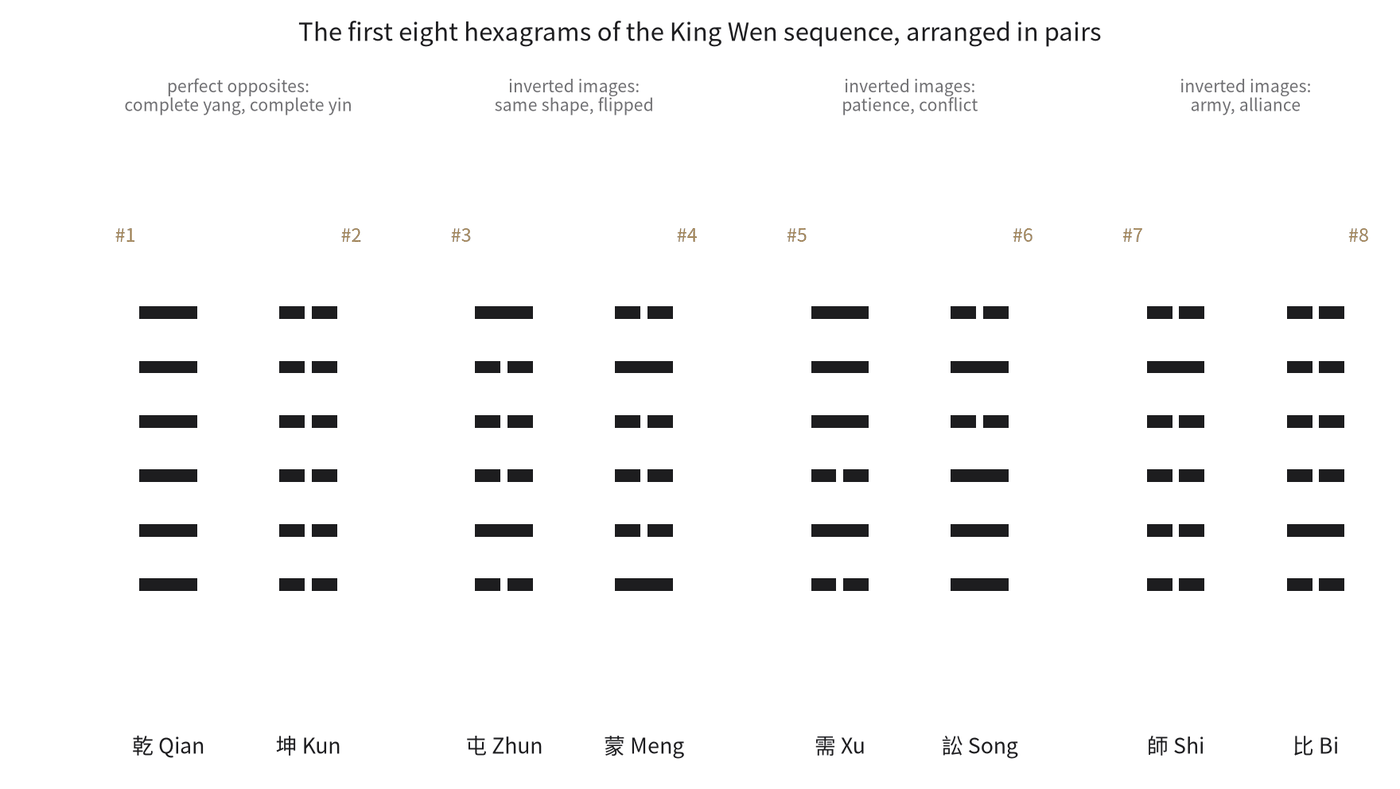
The organizing principle of the King Wen Sequence (文王卦序) relies on strict structural pairing. Every hexagram in the text is paired with the hexagram immediately following it (1 with 2, 3 with 4, 5 with 6, and so forth) according to one of two geometric rules:
- Inversion (Reversal of Lines): In fifty-six of the sixty-four cases, a hexagram is paired with its spatial inversion: the exact same line structure turned upside down. For example, Hexagram 11 (Tai / Peace), which has Three Earth lines over Three Heaven lines, when turned upside down becomes Hexagram 12 (Pi / Stagnation), which has Three Heaven lines over Three Earth lines.
- Total Opposition (Polar Reversal): In eight specific cases, turning a hexagram upside down leaves its visual structure completely unchanged because the hexagram is symmetrical (such as Hexagram 1 Qian, Hexagram 2 Kun, Hexagram 27 Yi, Hexagram 28 Da Guo, Hexagram 29 Kan, Hexagram 30 Li, Hexagram 61 Zhong Fu, and Hexagram 62 Xiao Guo). In these eight cases, the hexagram is paired with its polar opposite: every single solid line is replaced with a broken line, and vice versa.
The traditional sequence is divided into two distinct books or canons:
- The Upper Canon (Hexagrams 1 to 30): Opens with Qian (Heaven) and Kun (Earth) and closes with Kan (Water) and Li (Fire). This section focuses on cosmic foundations, natural laws, planetary rhythms, and primary forces of the natural universe.
- The Lower Canon (Hexagrams 31 to 64): Opens with Xian (Influence / Attraction) and Heng (Duration) and closes with Ji Ji (After Completion) and Wei Ji (Before Completion). This section focuses on human relationships, governance, social structures, and emotional transitions.
Notice the philosophical profundity of how the sequence ends. Hexagram 63 is Ji Ji (After Completion), where every single line is in its perfectly balanced position (odd lines solid, even lines broken). If the text ended there, it would imply that history reaches a static, perfect resting point. But the sequence ends with Hexagram 64: Wei Ji (Before Completion), where every line is out of place. This final placement reminds us that completion is an illusion; the cycle immediately resets, demanding renewed awareness and active engagement.
To assist in building hexagrams from trigram combinations, the matrix below acts as a quick structural lookup table, showing how upper and lower trigrams intersect to form foundational hexagrams:
| Upper Trigram ↓ / Lower Trigram ➔ | Qian (☰ Heaven) | Kun (☷ Earth) | Kan (☵ Water) | Li (☲ Fire) |
|---|---|---|---|---|
| Qian (☰ Heaven) | Hexagram 1: Qian (The Creative) | Hexagram 11: Tai (Peace) | Hexagram 5: Xu (Waiting) | Hexagram 14: Da You (Great Possession) |
| Kun (☷ Earth) | Hexagram 12: Pi (Stagnation) | Hexagram 2: Kun (The Receptive) | Hexagram 8: Bi (Holding Together) | Hexagram 35: Jin (Progress) |
| Kan (☵ Water) | Hexagram 6: Song (Conflict) | Hexagram 7: Shi (The Army) | Hexagram 29: Kan (The Abyssal Water) | Hexagram 63: Ji Ji (After Completion) |
| Li (☲ Fire) | Hexagram 13: Tong Ren (Fellowship) | Hexagram 36: Ming Yi (Darkening of Light) | Hexagram 64: Wei Ji (Before Completion) | Hexagram 30: Li (The Clinging Fire) |
This structural pairing demonstrates that no state in the I Ching exists in isolation. Strength (Qian) naturally finds its balance in receptivity (Kun); initial difficulty (Chun) is followed by youthful education (Meng); peace (Tai) inevitably contains the seeds of future stagnation (Pi) if vigilance wanes. Recognizing these structural pairs teaches you to see where your current situation sits on the cosmic pendulum.
Full Worked Consultation: Walking Through a Real Case Step by Step
To see how all these mechanics operate in practice, let’s walk through a complete consultation. Note that this scenario is a constructed case study built around my friend Wei Ming to demonstrate line generation, trigram assembly, commentary lookup, and strategic synthesis.
Scenario Context: Wei Ming is the chief technical officer and co-founder of a software firm. His team manages a ten-year-old monolithic codebase that powers their primary revenue product. The code is fragile, slow to deploy, and hard to scale. Wei Ming wants to execute a full microservices architectural rewrite during Q4, but his co-founder fears business disruption and budget overruns.
Formulating the Query: Wei Ming sits down at his kitchen table, quietens his mind, and writes out his query by hand:
“What is the strategic nature of the situation and optimal operational posture if we initiate a full microservices architectural rewrite during Q4?”
Step 1: The Casting Process
Wei Ming uses three identical copper coins. He shakes them in his hands and performs six consecutive tosses, recording each result immediately from bottom to top:
- Toss 1 (Line 1, Bottom): Coins land Tails, Heads, Tails (2 + 3 + 2 = 7). Recorded as static solid line: ⚊
- Toss 2 (Line 2): Coins land Heads, Heads, Heads (3 + 3 + 3 = 9). Recorded as moving solid line: ⚊ (marked with an O)
- Toss 3 (Line 3): Coins land Tails, Heads, Heads (2 + 3 + 3 = 8). Recorded as static broken line: ⚋
- Toss 4 (Line 4): Coins land Tails, Heads, Tails (2 + 3 + 2 = 7). Recorded as static solid line: ⚊
- Toss 5 (Line 5): Coins land Tails, Heads, Tails (2 + 3 + 2 = 7). Recorded as static solid line: ⚊
- Toss 6 (Line 6, Top): Coins land Tails, Tails, Tails (2 + 2 + 2 = 6). Recorded as moving broken line: ⚋ (marked with an X)
Step 2: Identifying the Primary Hexagram
Wei Ming stacks the six lines from bottom to top to assemble his Primary Hexagram:
- Line 6 (Top): ⚋ (Old Yin 6)
- Line 5: ⚊ (Young Yang 7)
- Line 4: ⚊ (Young Yang 7)
- Line 3: ⚋ (Young Yin 8)
- Line 2: ⚊ (Old Yang 9)
- Line 1 (Bottom): ⚊ (Young Yang 7)
Now he breaks the stack into lower and upper trigrams to identify the hexagram:
- Lower Trigram (Lines 1, 2, 3): Solid, Solid, Broken (⚊ ⚊ ⚋). Looking up the eight trigrams, this is Dui (兑 / Lake), associated with joyous communication and open exchange.
- Upper Trigram (Lines 4, 5, 6): Solid, Solid, Broken (⚊ ⚊ ⚋). This is also Dui (兑 / Lake).
Lake over Lake yields Hexagram 58: Dui (兑 / The Joyous Exchange). The primary theme of Hexagram 58 is open discussion, mutual encouragement, transparent communication, and persuasive dialogue among colleagues.
Step 3: Deriving the Secondary Hexagram
Wei Ming has two moving lines: Line 2 (Old Yang 9) and Line 6 (Old Yin 6). He redrafts the hexagram, transforming Line 2 into a broken line and Line 6 into a solid line:
- Line 6 (Top): ⚋ transforms into ⚊ (Solid)
- Line 5: ⚊ remains ⚊ (Solid)
- Line 4: ⚊ remains ⚊ (Solid)
- Line 3: ⚋ remains ⚋ (Broken)
- Line 2: ⚊ transforms into ⚋ (Broken)
- Line 1 (Bottom): ⚊ remains ⚊ (Solid)
Evaluating the transformed trigrams for the Secondary Hexagram:
- Transformed Lower Trigram (Lines 1, 2, 3): Solid, Broken, Broken (⚊ ⚋ ⚋). This is Zhen (震 / Thunder), representing movement and sudden initiative.
- Transformed Upper Trigram (Lines 4, 5, 6): Solid, Solid, Solid (⚊ ⚊ ⚊). This is Qian (乾 / Heaven), representing raw creative force and unyielding strength.
Heaven over Thunder yields Hexagram 34: Da Zhuang (大壮 / Great Power). The secondary hexagram indicates high energy, massive momentum, and structural force that must be managed with extreme discipline so it does not turn into reckless arrogance.
Step 4: Reading the Textual Commentaries
Following Zhu Xi’s guidance for two moving lines, Wei Ming reads the Judgement of Primary Hexagram 58, then focuses primarily on the two moving line statements (Line 2 and Line 6), placing special weight on Line 6 as the upper line.
Judgement of Hexagram 58 (Dui / Joyous Exchange): “The Joyous. Success. Perseverance is favorable.” The commentary emphasizes that success comes through transparent, persuasive dialogue and alignment with stakeholders rather than unilateral mandates.
Line 2 Statement (Old Yang in 2nd position): “Sincere devotion brings good fortune. Regret vanishes.” Paraphrase: When you act out of genuine dedication to structural quality rather than personal vanity, you win trust, and early anxiety disappears.
Line 6 Statement (Old Yin in 6th position – Primary Focus): “Seductive joy leads off course.” Paraphrase: At the peak of enthusiasm, getting swept away by fashionable trends or over-ambitious grand designs without firm grounded constraints leads to delusion and wasted energy.
Step 5: Examining the Non-Moving Context Lines
To deepen his understanding, Wei Ming briefly reviews the static lines in his primary hexagram (Lines 1, 3, 4, and 5) to understand the background environment:
- Line 1 (Static Yang): Foundational harmony. Grounding the engineering proposal in clear, undeniable technical data creates an initial baseline of trust.
- Line 3 (Static Yin): Warns against superficial charm. He must not promise executive teams unrealistic delivery dates just to win immediate approval.
- Lines 4 & 5 (Static Yang): Executive alignment. Maintaining open dialogue with his co-founder stabilizes the project’s institutional backing.
Step 6: Practical Strategic Synthesis and Action Plan
Wei Ming connects the symbolic reading directly to his engineering dilemma:
- The Current Atmosphere (Hexagram 58 – Joyous Exchange): The rewrite cannot be forced as a top-down mandate. Wei Ming must use transparent communication, consulting with his co-founder and senior developers to build genuine consensus.
- The Operational Advice (Line 2 – Sincere Devotion): Focus on core architectural stability. His motivation must be pure technical quality, not ego or trend-chasing.
- The Core Warning (Line 6 – Seductive Joy): The top moving line warns against seductive, over-ambitious scope creep. Attempting a total, blind microservice overhaul during Q4 would be “seductive joy” leading off course.
- The Future Vector (Hexagram 34 – Great Power): If executed with strict constraints, the rewrite generates immense power and performance, but raw power without guardrails causes structural damage.
Wei Ming leaves his consultation with a clear operational posture: he will not launch a total teardown in Q4. Instead, he presents a phased, modular migration plan to his co-founder, building trust through consensus while keeping the microservice scope tightly constrained.
Common Pitfalls: Seven Ways Your Brain Will Try to Cheat the Coins
The coins never lie, but your ego lies to you every single day. Working with the I Ching requires rigorous mental discipline. Because the text operates as a symbolic mirror, an untrained mind will distort the reflection, projecting personal desires, fears, and biases onto the line statements. Below are the seven most common traps practitioners fall into, along with protocols to avoid them:
1. Outcome Fishing (Re-Casting the Coins)
Outcome fishing occurs when you get an answer you dislike, so you immediately gather up the coins and toss them again, hoping for a more flattering hexagram. This practice destroys the psychological integrity of the consultation. If you cast coins repeatedly until you get a pleasant result, you are not consulting an oracle; you are validating your own stubbornness. Accept the first cast completely. If the result is uncomfortable, sit with that discomfort and analyze why your ego resists the reflection.
2. Over-Consultation and Decision Paralysis
Some beginners develop an unhealthy dependency on the I Ching, casting hexagrams for trivial daily choices: what to eat for lunch, which shirt to wear, or whether to send an email at 2:00 PM versus 3:00 PM. This habit degrades your personal decision-making capacity and reduces an ancient philosophical system to a neurotic crutch. Reserve formal consultations for major strategic dilemmas, recurring personal impasses, or complex transitions where your internal compass is genuinely stuck.
3. Confirmation Bias and Selective Reading
Human beings are experts at extracting validation from neutral statements while ignoring clear warnings. If a reading contains four lines of stern caution about financial overextension and one minor line mentioning ultimate success after long delay, an overly optimistic practitioner might focus entirely on the promise of success while ignoring the financial warnings. To combat this bias, read the warning lines first and write down their concrete implications before reading any encouraging commentary.
4. Hyper-Literal Symbolism
As noted earlier, mistaking ancient Bronze Age metaphors for literal predictions causes unnecessary confusion. If a line mentions “losing one’s horse,” do not spend your afternoon checking your garage for an escaped stallion. Translate the metaphor into its modern functional equivalent: losing a primary transport asset, a core delivery channel, or a key vehicle of momentum. Translate the functional essence of the image, not its Bronze Age surface.
5. Treating the Text as Absolute Fate
The I Ching shows current tendencies and prospective vectors, not unchangeable destinies. A favorable hexagram does not guarantee victory if you become lazy and careless. An unfavorable hexagram does not doom you to failure if you take prudent corrective action to mitigate risk. The hexagram describes the momentum of the field; your choices determine how you navigate that momentum.
6. The Mystical Savior Complex
This trap occurs when a practitioner expects the consultation to magically resolve their life without personal effort. The I Ching provides strategic perspective, but it will not write your software code, pay your mortgage, or fix your broken communication habits. You remain the executive actor responsible for executing choices in the real world.
7. Ego Projection and Grandiose Identification
When reading classical line texts that reference “the Great Prince,” “the Wise King,” or “the Sovereign,” beginners often assume these grandiose titles refer directly to their personal ego. In reality, these terms describe an operational posture of high moral authority, calm discipline, and self-restraint. Identify with the discipline required by the role, not the vanity of the title.
Journaling and Audits: How to Keep Your Practice Honest
Unrecorded divination is just emotional entertainment. If you do not write down your readings and audit them months later, your memory will rewrite history to make you look smart.
Without written records, memory quickly rewrites past expectations. When events turn out poorly, you might convince yourself that you foresaw the collapse all along. When events turn out well, you might forget that the text explicitly warned you against taking a specific risk. A dedicated logbook keeps your practice grounded in empirical evidence.
Designing Your I Ching Consultation Logbook
For every consultation, record the following core data points in a dedicated notebook or structured digital file:
- Date and Time: The exact date, time, and physical context of the reading.
- The Query: The exact wording of your question as formulated before casting.
- Method Used: Note whether you used coins, yarrow stalks, or another recognized technique.
- Raw Toss Values: Write down the six numerical toss values (e.g., 7-9-8-7-7-6) from bottom to top.
- Primary & Secondary Hexagrams: Note hexagram numbers, names, and constituent trigrams.
- Moving Lines: Highlight the specific line numbers that changed.
- Immediate Interpretation: Write a brief summary of what the reading means for your decision.
- Executed Action: Document the concrete choices you made based on the consultation.
- 60-Day Audit Outcome: Revisit the entry two months later to record actual real-world results.
Example Journal Entry and Audit Record
The table below demonstrates a complete log entry based on Wei Ming’s consultation regarding his Q4 architectural migration:
| Log Field | Journal Entry Data | 60-Day Audit Notes |
|---|---|---|
| Date & Context | October 12, 2026 / Seattle Kitchen Table | Audit Conducted: December 14, 2026 |
| Formulated Query | “What is the strategic posture if we initiate a microservices rewrite in Q4?” | Query focus on Q4 migration posture was exact and actionable. |
| Raw Toss Values | 7 – 9 – 8 – 7 – 7 – 6 (Bottom to Top) | Line 2 (Old Yang) and Line 6 (Old Yin) moving. |
| Hexagram Pair | Primary 58 (Dui / Joyous) ➔ Secondary 34 (Da Zhuang / Great Power) | Primary reflected consultation; secondary reflected migration power. |
| Strategic Takeaway | Do NOT execute total teardown. Pitch modular migration; avoid scope creep (Line 6). | Avoided catastrophic Q4 downtime by rejecting total rewrite proposal. |
| Action Executed | Presented phased modular plan to co-founder; decoupled payment module first. | Co-founder approved modular approach; payment service deployed smoothly. |
| Real-World Outcome | Payment service live with 40% performance gain. Zero downtime during peak sales. | Line 6 caution against “seductive joy” saved the company from code bloat. |
By auditing your journal entries twice a year, you will begin to notice personal patterns. You will discover which hexagrams appear frequently during specific life transitions, how your mind tends to interpret particular line statements, and whether your strategic decisions improved after heeding the commentary warnings.
A semi-annual audit protocol is simple: open your logbook every June and December, count the total consultations performed, classify the queries into categories (career, relationships, financial, personal growth), and measure your decision success rate. If you find that 80% of your readings in career led to positive outcomes while 50% in relationships led to confusion, you have identified a personal cognitive bias in how you interpret relational hexagrams versus business hexagrams.
Frequently Asked Questions: Real Answers for Real Diviners
Got edge cases? Here are straight answers to the ten questions every serious practitioner asks eventually.
1. Can I use digital coin rollers or casting apps instead of physical coins?
You can, but physical tools are generally preferable. Pseudo-random number generators in software applications are technically functional, but handling physical coins engages your motor senses, forcing your mind to slow down and focus on the query. The physical ritual creates a clear psychological boundary between everyday digital noise and strategic reflection. Flipping metal on wood grounds your intention in the physical present.
2. What should I do if a coin lands on its edge or falls off the table?
If a coin rolls off the desk onto the floor or rests precariously on its edge against a book, do not try to guess its value. Pick up that specific set of three coins, take a breath, refocus on your written query, and re-cast that specific line. Do not restart the entire consultation from Line 1; simply repeat the toss for the line that was disrupted.
3. Can I cast the I Ching on behalf of someone else without their knowledge?
It is best to cast only for situations where you have direct personal agency or involvement. Consultation works as a mirror for your own judgment and conduct. Asking about someone else’s private feelings or secrets without their participation often turns into invasive curiosity or psychological projection. Focus on your own posture relative to that person rather than trying to divine their unexpressed thoughts.
4. How often should I consult the Book of Changes?
There is no fixed quota, but consulting the text once or twice a month for major strategic reviews is a healthy cadence. Avoid casting daily readings unless you are conducting a quiet, non-attached study of hexagram line mechanics. If you find yourself flipping coins multiple times a week for minor choices, pause and reset your practice to avoid decision fatigue and dependency.
5. What if the Judgement text seems completely contradictory or incomprehensible?
If a text seems contradictory, look at the constituent trigrams and the line positions. Classical translations often contain compressed poetic imagery that requires patient reflection. Break the reading down structurally: examine the relationship between the inner trigram and outer trigram, check whether your moving lines are in strong positions (lines 2 and 5), and review the nuclear hexagram for hidden pressures. Let the structural architecture explain the poetic paradox.
6. Is the yarrow stalk method objectively superior to the coin method?
The yarrow stalk method is not objectively superior, but it is traditionally preferred by serious scholars because of its asymmetric probability distribution and meditative tempo. The yarrow method produces fewer Old Yin lines (6.25%) and more Old Yang lines (18.75%), reflecting ancient cosmological views on the transient nature of active expansion compared to static receptivity.
7. Why does the I Ching use binary lines instead of four or five element categories like other systems?
The binary system of solid (yang) and broken (yin) lines represents the fundamental duality of nature at its most elegant level: light and dark, active and receptive, 1 and 0. By combining these binary units into trigrams and hexagrams, the system generates complex combinatorial models capable of mapping dynamic transitions without needing redundant classification categories. Modern digital computation relies on this exact same binary principle.
8. How do I handle readings when two moving lines give seemingly opposite advice?
When two moving lines appear to contradict each other, recognize that they represent two different stages or aspects of the situation. The lower moving line describes the immediate, emerging phase, while the upper moving line describes a more mature, advanced phase. Song Dynasty scholar Zhu Xi advised focusing primarily on the upper moving line, using the lower moving line as supporting contextual background.
9. What is the role of nuclear hexagrams in resolving ambiguous consultations?
Nuclear hexagrams (Huo Gua) reveal the underlying internal pressures within a situation. If a primary hexagram seems quiet or encouraging on the surface, but its nuclear hexagram is Hexagram 29 (Kan / The Abyssal Water) or Hexagram 39 (Jian / Obstruction), the text is warning you that severe structural tension is brewing beneath surface appearances. The surface hexagram shows the facade; the nuclear hexagram shows the engine room.
10. Is it necessary to learn classical Chinese to consult the I Ching effectively?
Learning classical Chinese is beneficial for deep academic research, but it is not required for practical consultation. High-quality English translations that preserve the structural integrity of the Zhouyi, such as those by Richard Wilhelm, Margaret Pearson, or Richard Rutt, provide complete access to the core wisdom of the text. Focus on understanding the structural mechanics first; linguistic nuances can be explored over time.
Where to go next
To situate a cast inside a full birth chart, see The Day Master Files, the complete BaZi reading guide. To time the action the coins just recommended, read the classical date selection field manual. To check the house you will do it in, the walkthrough of a real feng shui audit is the companion piece. And for a gentler first date with the oracle itself, our beginner guide to the I Ching remains the softer door.
Leave a Reply
You must be logged in to post a comment.